Last reviewed: October 25, 2026. This guide does not rank products and this site has not tested any headset. It compares what to check, using one manufacturer's published helicopter headset pages, a flight school's published fee estimate and Robinson Helicopter Company's course page, each retrieved on the date shown. We did not find a primary source with current retail prices, so we give none beyond one school's estimate.
"Best" depends on the aircraft, the budget and the person wearing it. A headset worn for hours in a loud helicopter needs to protect hearing, fit comfortably and connect correctly to the aircraft. This guide lists the criteria that matter for helicopter students, shows what one maker's helicopter models say about each, and gives questions to ask before buying.
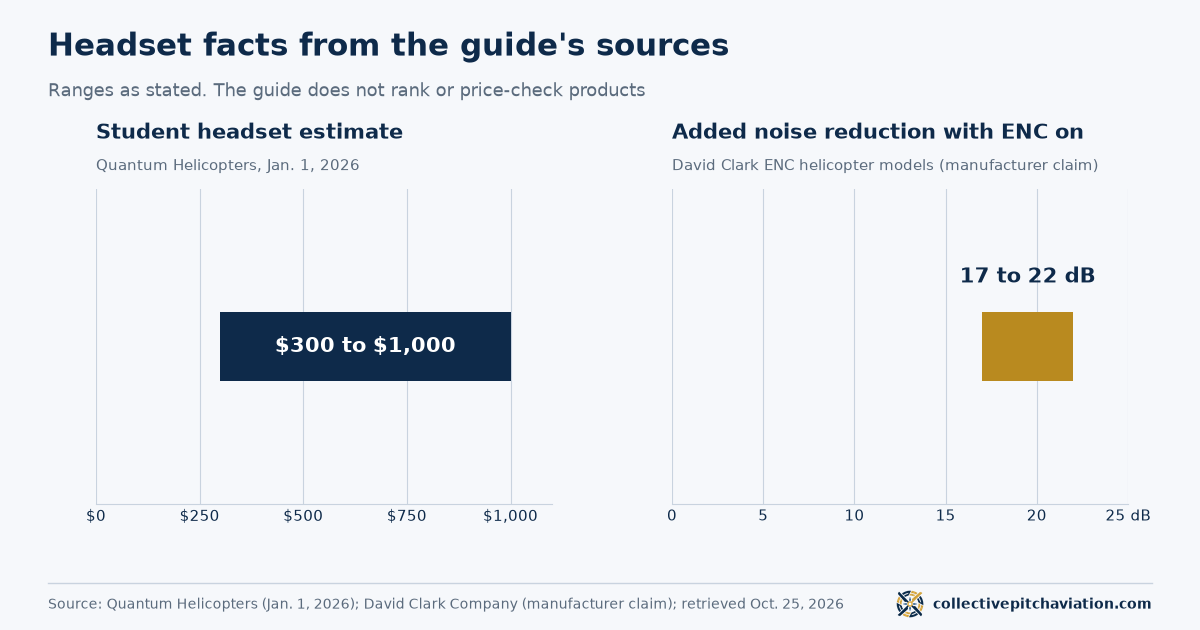
Quick answerChoose on fit with the aircraft (the plug), noise protection, comfort, power, standards, warranty and cost. Quantum Helicopters estimates a student headset at $300 to $1,000 (Jan. 1, 2026). David Clark Company says its helicopter headsets come with a 5-foot extended coil cord and a U-174/U single plug, and lists FAA TSO approval C57b and C58a for one passive model (davidclarkcompany.com, retrieved Oct. 25, 2026). Ask your school what it expects before buying.
Why helicopter headsets differ
Our training cost guide lists a headset among the costs people forget. Quantum Helicopters estimates $300 to $1,000 (Jan. 1, 2026). Robinson Helicopter Company's Pilot Safety Course asks attendees to bring a headset on flight day (robinsonheli.com, retrieved Oct. 25, 2026). Ask the school when a headset is needed and whether it lends one for early lessons (see discovery flights).
David Clark Company, a headset maker, says its helicopter headsets have the same comfort and performance features as its fixed-wing models, but come with a 5-foot extended coil cord with a U-174/U single plug (davidclarkcompany.com, Helicopter Headsets (Passive), retrieved Oct. 25, 2026). The practical point is that plug and cord style are part of the purchase, so a headset built for one kind of aircraft may not connect to another without an adapter.
Criteria to compare
| Criterion |
What to check |
Why it matters |
| Plug and cord |
Does the plug match the aircraft's jacks? Is the cord long enough? |
A headset that does not connect, or that is awkward to plug in, is of no use on lesson day |
| Passive or noise cancelling |
Passive headsets reduce noise by their construction; electronic models add active noise cancelling |
Affects comfort and hearing protection over long sessions; costs and weight differ |
| Noise cancelling claim |
Is the maker's decibel figure stated, and how was it measured? |
David Clark says its ENC helicopter headsets provide an additional 17 to 22 dB attenuation over passive noise reduction with ENC activated (manufacturer claim) |
| Standards |
Is the headset listed as meeting an FAA technical standard order? |
David Clark lists FAA TSO C57b and C58a for its H10-13H passive helicopter model |
| Power |
Batteries or aircraft power? How long does a set last? |
David Clark says the control module for its DC ONE-XH helicopter model runs on two AA batteries for up to 50 hours |
| Microphone |
Is the boom adjustable? Does it have noise cancelling? |
Communication clarity matters when you are learning radio calls |
| Comfort |
Weight, clamping force, head pad, ear seals |
Long lessons make fit more important than features |
| Compatibility |
Does it work with your eyewear, hat or helmet? |
Try it on |
| Connectivity |
Bluetooth or music input, if wanted |
Optional; check how it behaves in flight |
| Warranty |
Length and what it covers |
David Clark states a five-year warranty on its headsets |
| Price and total cost |
Price, plus batteries, replacement ear seals and microphones |
See below |
Each manufacturer states its own specifications. The table cites David Clark because its helicopter pages were available to us; other manufacturers also make helicopter-compatible headsets, and we did not review their pages for this edition. Apply the same questions to any maker.
Passive versus electronic noise cancelling
A passive headset has no electronics for noise cancelling. Its protection comes from the ear cups and seals. An electronic noise cancelling headset adds circuitry that works against engine and rotor noise. David Clark says its ENC helicopter models are designed to provide an additional 17 to 22 dB of attenuation above passive reduction with ENC on (davidclarkcompany.com, Helicopter Headsets (ENC), retrieved Oct. 25, 2026). That is the manufacturer's claim, not independent testing.
Makers use different names for this feature (ENC, active noise reduction and others), so compare what each claims and how, rather than assuming equal meanings.
Which type suits a student depends on budget, hours flown per week and personal comfort. This guide does not recommend one; ask instructors at your school what they use and why, and try headsets on if you can.
What the manufacturer pages show
The following is a summary of David Clark's published descriptions, to illustrate how to read a spec page (davidclarkcompany.com, retrieved Oct. 25, 2026). It is not a recommendation.
- H10-13H (passive, helicopter). Described as one of the maker's best-selling helicopter headsets. Features listed include a double foam head pad, gel ear seals, reduced headband force, a flexible boom, a noise-cancelling microphone, a low-profile volume knob, a molded cord, a 5-year warranty, a 5-foot extended coil cord and FAA TSO approvals C57b and C58a.
- DC ONE-XH (ENC, helicopter). Described as hybrid electronic noise cancellation with digital signal processing and Bluetooth, a stereo/mono switch, an in-line control module powered by two AA batteries for up to 50 hours, a 5-foot extended coil cord with U-174/U plug and a vented head pad.
Read competing makers' pages the same way: note the plug, the standards listed, the power source, the warranty and what is measured.
How to avoid common mistakes
- Buying before asking the school. Some schools have preferences or lend headsets for early lessons. Ask what the instructor expects.
- Treating price as the only factor. A low price may mean a short warranty or poor fit. A high price may include features a student does not need.
- Skipping the fit test. Try it on with your eyewear and a hat or cap if possible.
- Ignoring the plug. Confirm the plug matches the school's helicopters.
- Not asking about returns. Buy from a seller with a return policy in case the fit is wrong.
- Ignoring employer rules. We found no source that says which headset any employer requires. If you have a target job, check the posting or ask; our job tracks guide shows where pilots go next.
A simple scoring sheet
Use the same sheet for each candidate so comparisons stay fair:
- Plug matches the school's aircraft (yes or no).
- Passive or ENC.
- FAA TSO listed (yes or no).
- Power source and battery life.
- Warranty length.
- Fit score from trying it on (1 to 5).
- Total price including any extras.
Weigh the answers against your budget. Compare two or three options before buying. The same method works for comparing schools; see flight school criteria.
Where headsets fit in the training budget
A headset is a one-time purchase compared with the hourly cost of flying. Published hourly rates for the R22 and R44 are in the R22 vs. R44 guide and the lessons cost guide. Weigh price together with fit and warranty, since a headset that does not fit may need replacing. The training stages guide shows when you will start flying regularly.
Frequently asked questions
What is the best headset for helicopter students?
No source ranks them for students. Choose on plug match, comfort, noise protection, power, warranty and cost, and ask your instructor what they use.
How much does a student helicopter headset cost?
Quantum Helicopters estimates $300 to $1,000 (Jan. 1, 2026). Prices vary by maker, model and retailer, so compare current listings.
Do you need a noise cancelling headset to start?
Not necessarily. The decision depends on budget and comfort. David Clark says its ENC helicopter models add 17 to 22 dB of attenuation over passive reduction (manufacturer claim).
Can you use an airplane headset in a helicopter?
It depends on the plug and the aircraft's jacks. David Clark's helicopter headsets come with a single U-174/U plug and an extended cord. Check compatibility with your school before buying.
Does the school provide a headset?
Some schools may for introductory flights; ask. Robinson's safety course says to bring one on flight day.
What does TSO mean on a headset?
It refers to an FAA technical standard order. David Clark lists TSO C57b and C58a for its H10-13H model. Check what a given standard covers on the FAA's own pages.
Sources
- David Clark Company, Helicopter Headsets (Passive). https://www.davidclarkcompany.com/aviation/helicopter-passive.php. Retrieved October 25, 2026.
- David Clark Company, Helicopter Headsets (ENC). https://www.davidclarkcompany.com/aviation/helicopter-enc.php. Retrieved October 25, 2026.
- Quantum Helicopters, Tuition and Other Estimated Fees (headset estimate), prices effective Jan. 1, 2026. https://www.quantumhelicopters.com/tuition-and-other-estimated-fees/. Retrieved October 25, 2026.
- Robinson Helicopter Company, Pilot Safety Course. https://www.robinsonheli.com/training/pilot-safety-course. Retrieved October 25, 2026.
Disclosure: this page may contain ads and affiliate links to headset retailers or brand programs. If you buy through a labeled link, we may earn a commission at no extra cost to you. Links do not change the criteria or the order of this page. See our advertising and affiliate disclosure. This is general information, not a product endorsement or hearing-protection advice.