Adding an airplane rating
The add-on rule (14 CFR 61.63)
Moving from rotorcraft to airplane is an additional aircraft category rating. Section 61.63(b) requires that the applicant:
- Complete the training and have the applicable aeronautical experience.
- Hold a logbook or training record endorsement from an authorized instructor attesting competence in the aeronautical knowledge areas and proficiency in the areas of operation.
- Pass the practical test.
- Need not take an additional knowledge test, provided the applicant holds an airplane, rotorcraft, powered-lift, weight-shift-control aircraft, powered parachute or airship rating at that pilot certificate level.
Once a pilot holds an airplane category rating, adding another airplane class (for example multiengine land after single-engine land) is a class rating under 61.63(c). AOPA summarizes that route: no minimum flight time for the class rating, two instructor endorsements, and a checkride (AOPA, Other Ratings and Endorsements).
The military conversion rule does not create airplane privileges from helicopter records. Section 61.73 ties the rating to the kind of aircraft category, class and type shown in the military records (see military to civilian).
Applicable experience at each certificate level
The "applicable aeronautical experience" comes from the rule for the certificate level.
Private pilot, airplane single-engine (14 CFR 61.109(a)). At least 40 hours of flight time including 20 hours of flight training from an authorized instructor and 10 hours of solo flight training. The training must include at least 3 hours of cross-country in a single-engine airplane; 3 hours of night training including a cross-country of over 100 nautical miles and 10 takeoffs and landings to a full stop; 3 hours of instrument training in a single-engine airplane; and 3 hours of training with an instructor in preparation for the practical test within the preceding 2 calendar months.
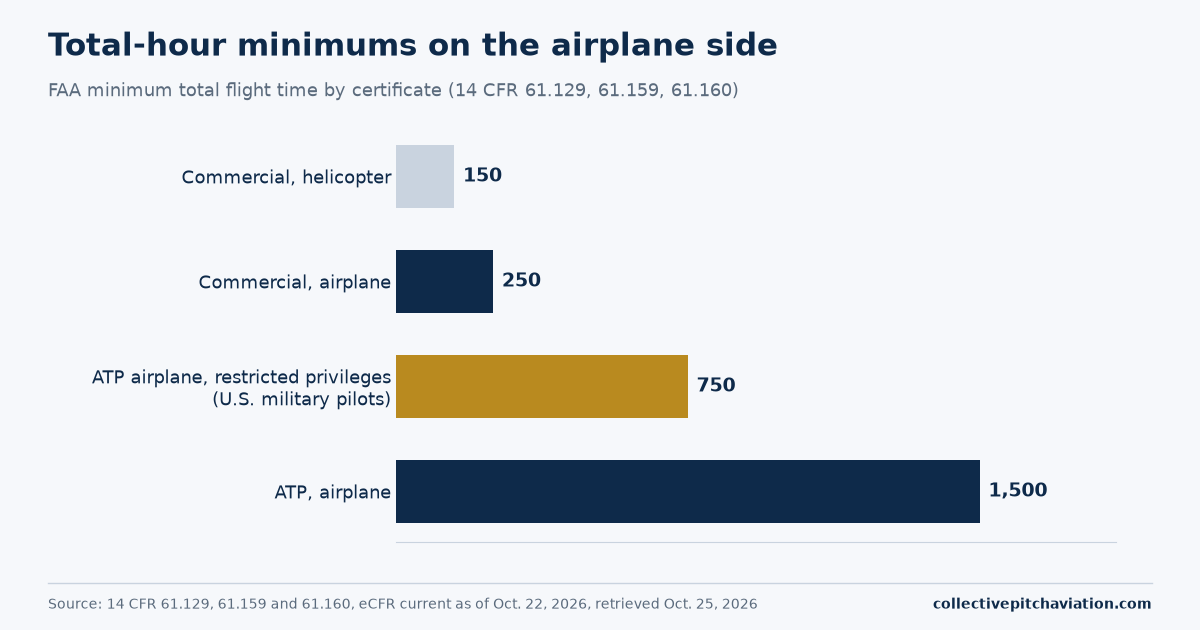
Commercial pilot, airplane (14 CFR 61.129(a) and (b)). At least 250 hours of flight time as a pilot, consisting of at least:
- 100 hours in powered aircraft, of which 50 must be in airplanes;
- 100 hours of pilot-in-command time, including at least 50 hours in airplanes and 50 hours of cross-country, of which at least 10 hours must be in airplanes;
- 20 hours of training, including 10 hours of instrument training (5 of those in a single-engine airplane for the single-engine rating, or in a multiengine airplane for the multiengine rating) and 10 hours of training in a complex, turbine-powered or technically advanced airplane (for multiengine, a multiengine complex or turbine-powered airplane);
- a 2-hour day cross-country and a 2-hour night cross-country each of more than 100 nautical miles; and
- solo or pilot-in-command requirements, including a 300 nautical mile cross-country with landings at three points and 5 hours of night VFR with 10 takeoffs and landings at a towered airport.
Compare the commercial helicopter rule, which needs 150 hours (14 CFR 61.129(c)). A commercial helicopter pilot typically has total hours but the airplane-specific lines have to be logged in an airplane.
Instrument rating, airplane (14 CFR 61.65(d)). 50 hours of cross-country time as pilot in command, of which 10 hours must be in an airplane, and 40 hours of actual or simulated instrument time, of which 15 hours must be from an instructor who holds an instrument-airplane rating, including 3 hours of instrument training in an airplane within 2 calendar months before the practical test and an IFR cross-country of 250 nautical miles with an approach at each airport and three kinds of approaches. Ask the school how an existing helicopter instrument rating is treated.
R-ATP and the hour credits (14 CFR 61.159 and 61.160)
The standard airplane ATP rule (61.159(a))
A person applying for an ATP certificate with an airplane category and class rating must have at least 1,500 hours of total time as a pilot that includes at least:
- 500 hours of cross-country time;
- 100 hours of night flight time;
- 50 hours of flight time in the class of airplane for the rating sought (a maximum of 25 hours of full flight simulator training may count if accomplished in an approved Part 121, 135, 141 or 142 course);
- 75 hours of instrument flight time in actual or simulated conditions, with limits on simulated time; and
- 250 hours of flight time in an airplane as pilot in command, or as second in command performing the duties of pilot in command under supervision, including at least 100 hours of cross-country and 25 hours of night flight.
Where military rotary time counts
The restricted-privileges rule is 14 CFR 61.160. Paragraph (a) says a U.S. military pilot or former military pilot (except someone removed from flying status for lack of proficiency or a disciplinary action involving aircraft operations) may apply for an ATP with an airplane category multiengine class rating, or an ATP with a multiengine airplane type rating, at a minimum of 750 hours of total time as a pilot. The applicant presents:
- An official Form DD-214 showing an honorable discharge, or an official military record showing the pilot is currently serving; and
- An official military record showing graduation from a military undergraduate pilot training school and a rating qualification as a military pilot.
The text says "total time as a pilot." It does not name helicopters or limit the type of aircraft. The credit is a lower total-hour threshold. It is not a credit toward the airplane items. Paragraph (e) says an applicant under these reduced totals "must otherwise meet" the experience requirements of 61.159, with the single change that 200 hours of cross-country time (instead of 500) is accepted. Rotary time therefore cannot fill the 50 hours in the class of airplane or the 250 hours of airplane pilot-in-command time.
Section 61.159(a)(5)(ii) does give military pilots one specific credit: flight time in a powered-lift aircraft operated in horizontal flight may count toward the 250 hours. The text names powered-lift, not helicopters.
Other pathways in 61.160:
| Path |
Total time as a pilot |
Section |
| U.S. military pilot or former military pilot |
750 hours |
61.160(a) |
| Bachelor's degree with aviation major from an institution holding an FAA letter of authorization, plus 60 semester credit hours of aviation coursework and Part 141 training |
1,000 hours |
61.160(b) |
| Associate's degree with aviation major under the same type of authorization, plus 30 semester credit hours |
1,250 hours |
61.160(c) |
| Graduate with fewer than 60 but at least 30 credit hours, meeting (b) otherwise |
1,250 hours |
61.160(d) |
| Any pilot, with 200 hours of cross-country and meeting 61.159 |
1,500 hours |
61.160(f) |
Age: an ATP obtained under 61.160 requires the applicant to be at least 21 (14 CFR 61.153(a)(2)). An ATP under 61.159 requires age 23 (61.153(a)(1)).
Limits that come with a restricted ATP
A certificate issued under 61.160 carries the limitation "Restricted in accordance with 14 CFR 61.167" (61.160(g)). Under 61.167(b), a holder who has not met the age and experience requirements may not act as pilot in command in Part 121 operations and certain Part 135 operations, with further limits in that section. The holder is entitled to a certificate without the limitation on presenting evidence that 61.159 and the age rule have been met. A separate ICAO limitation may also apply (61.160(h)).
AOPA's plain-language summary says military pilots can receive a restricted ATP with 750 hours of experience, four-year aviation college graduates with 1,000, and two-year graduates with 1,250, and that every category has sub-requirements (AOPA, Airline Transport Pilot).
Airlines with published rotor transition programs
The table lists only airlines whose own pages describe a rotor-pilot pathway. Each airline sets its own terms, and the pages below were read on the retrieval date.
| Airline |
What its page says |
Who it covers |
| Frontier Airlines, Rotor Transition Program |
Application window "temporarily closed" when read. For U.S. military-trained helicopter aviators who graduated from a U.S. Armed Forces pilot training school, hold a DD-214 or are within twelve months of separating, and will be eligible for the R-ATP under 61.160 within two years. No fixed-wing time is required to start. To complete: 750 total time, including 250 fixed-wing PIC, 100 fixed-wing PIC cross-country, 25 fixed-wing night PIC and 25 fixed-wing "multi." A $50,000 sign-on bonus is described as available to fund fixed-wing training, an ATP course and a jet transition course. Program length is estimated at one month to five months depending on hours needed. |
U.S. military-trained pilots only; the page says civilian helicopter pilots are not covered |
| SkyWest Airlines, Rotor Transition Program |
Page describes a path for rotor pilots. Candidates apply as first officers within 4 to 6 months of meeting ATP or R-ATP requirements. Lists 250 PIC or SIC acting as PIC, 100 PIC cross-country, 25 PIC night and 25 hours multi in an airplane. |
Rotor pilots; the bonus is for military aviators |
| GoJet Airlines, Rotor Transition |
Says it will fund up to $35,000 of fixed-wing training for rotor pilots short of ATP or R-ATP minimums. Military rotor pilots: 750 total time including 250 fixed-wing PIC, 200 cross-country, 100 night (or 75 night with 25 night landings), 75 instrument and 25 multiengine. Civilian rotor pilots: 1,500 total time including 250 PIC, the same 200, night, 75 instrument and 25 multiengine hours, and a commercial rotor license. Fully qualified military pilots can earn up to 6 months of early seniority. |
Military and civilian rotor pilots, with different totals |
The table shows the consistent theme. Programs that cover military pilots use the 750-hour R-ATP total, but still require airplane PIC time, cross-country, night and multiengine hours.
Southwest Airlines publishes a Destination 225 Military Pathway aimed at current or former U.S. military pilots with some fixed-wing turbine time, who may use SkillBridge and the GI Bill. Its page said applications were closed when read. Because it asks for fixed-wing turbine experience, it is not a rotor-only program (careers.southwestair.com, Destination 225 Military). Pages for other airlines were not checked or could not be read, so their absence from this list says nothing about their programs.
Cost and timeline from published school rates
Hillsboro Aero Academy publishes airplane prices effective November 1, 2026. Selected lines from its airplane page:
| Item |
Price |
| Cessna 152 |
$167 an hour |
| Cessna 172P and 172SP |
$221 an hour |
| Piper Seminole (PA-44), multiengine |
$475 an hour |
| Flight and ground instruction |
$90 an hour |
| Simulators (FRASCA and Redbird) |
$98 an hour |
| FAA written exam |
$175 |
| Practical exam paid to the examiner |
$1,000 to $1,400 or more |
| Private pilot certificate, airplane (average-hours package) |
$16,337.50 |
| Instrument rating, airplane (average-hours package) |
$12,809.50 |
| Commercial pilot, single and multiengine (average-hours package) |
$36,320.50 |
The school notes that totals are based on averages and that fuel surcharges are set by market rates. Its commercial package includes 15 hours of multiengine dual in the PA-44 at $8,475 and $712.50 of airplane rental for the multiengine practical test. Fifteen hours at the Seminole rate plus instruction is $475 + $90 = $565 an hour, and 15 x $565 = $8,475, which matches the school's line (our arithmetic).
Our arithmetic (illustration, not a quote): Building the airline-listed 250 hours of airplane pilot-in-command time in a Cessna 172 at $221 an hour is 250 x $221 = $55,250 in rental alone, before fuel surcharges, instruction and tax. Twenty-five multiengine hours in the Seminole at $475 an hour is 25 x $475 = $11,875. These are rental-only figures from one school and show why airlines such as Frontier and GoJet describe funding for the fixed-wing portion. Many pilots build airplane time through instructing or other flying instead of renting.
The only published timeline for the transition is Frontier's own estimate of one month to five months, depending on how many airplane hours are needed. Schools describing accelerated rotor-to-airplane courses were not used here.
What to keep flying and recording
- Keep a clean category-by-category logbook. The R-ATP items are airplane items: airplane PIC, airplane cross-country, airplane night, multiengine. Log them separately from rotor time (14 CFR 61.51).
- Stay current in helicopters if helicopter jobs remain an option. Air Methods says that if a candidate has not flown in category within the previous 24 months, the chief pilot determines viability (Air Methods Pilot Careers).
- Keep military paperwork. The DD-214 and the undergraduate pilot training record are what 61.160(a) asks for, and Frontier requires a DD-214 or separation within twelve months.
- Mind the clock. Frontier asks that candidates be eligible for the R-ATP within two years, and SkyWest asks candidates to apply within 4 to 6 months of meeting ATP or R-ATP requirements.
See airplane to helicopter for the reverse direction, military to civilian for the conversion rule, and helicopter pilot jobs for rotor careers.
Frequently asked questions
How many hours does a military helicopter pilot need for a restricted ATP?
14 CFR 61.160(a) sets a minimum of 750 hours of total time as a pilot for a U.S. military pilot or former military pilot who presents a DD-214 or current service record and a military undergraduate pilot training record. The applicant must otherwise meet 61.159, with 200 hours of cross-country accepted.
Does helicopter time count toward the airplane hours?
Rotor time counts as "total time as a pilot." It does not count toward the airplane-specific items such as 50 hours in the class of airplane or 250 hours of airplane pilot-in-command time. The one military credit named in 61.159(a)(5)(ii) is for powered-lift time in horizontal flight.
Which airlines have rotor transition programs?
Frontier, SkyWest and GoJet describe rotor transition programs on their own pages. Frontier's covers U.S. military-trained pilots only, and its application window was closed when read. Southwest's military pathway asks for fixed-wing turbine time.
Do civilian helicopter pilots qualify for these programs?
GoJet's page lists civilian rotor pilots at 1,500 total time with a commercial rotor license. Frontier's page says its program is for U.S. military-trained aviators only. SkyWest's page speaks of rotor pilots; check it for any current incentives.
Is an airplane add-on enough for an airline job?
No. The add-on rating only qualifies the pilot to fly airplanes. Airline hiring depends on meeting ATP or R-ATP experience, which includes airplane-specific hours.
Sources
- U.S. Code of Federal Regulations, Title 14, sections 61.51, 61.63, 61.65, 61.73, 61.109, 61.129, 61.153, 61.159, 61.160 and 61.167, eCFR text current as of October 22, 2026. https://www.ecfr.gov/current/title-14/chapter-I/subchapter-D/part-61. Retrieved October 25, 2026.
- AOPA, Airline Transport Pilot. https://www.aopa.org/training-and-safety/learn-to-fly/flying-for-a-career/airline-transport-pilot. Retrieved October 25, 2026.
- AOPA, Other Ratings and Endorsements. https://www.aopa.org/training-and-safety/active-pilots/ratings-and-endorsements/other-ratings. Retrieved October 25, 2026.
- Frontier Airlines, Rotor Transition Program. https://www.flyfrontier.com/careers/pilot/rotor-transition-program/. Retrieved October 25, 2026.
- SkyWest Airlines, Rotor Transition Program. https://www.skywest.com/skywest-airline-jobs/career-guides/rotor-transition-program. Retrieved October 25, 2026.
- GoJet Airlines, Rotor Transition. https://gojetairlines.com/rotor-transition/. Retrieved October 25, 2026.
- Southwest Airlines, Destination 225 Military Pathway. https://careers.southwestair.com/us/en/D225Military. Retrieved October 25, 2026.
- Hillsboro Aero Academy, Airplane Rates and Fees, prices effective Nov. 1, 2026. https://flyhaa.com/airplane-rates/. Retrieved October 25, 2026.
- Air Methods, Pilot Careers. https://www.airmethods.com/roles-at-air-methods/pilots/. Retrieved October 25, 2026.
Disclosure: this page may contain ads and links. Sponsored items are always labeled. See our disclosure(/advertising-and-affiliate-disclosure/). This is general information, not career, legal or financial advice.