What the data says about the market
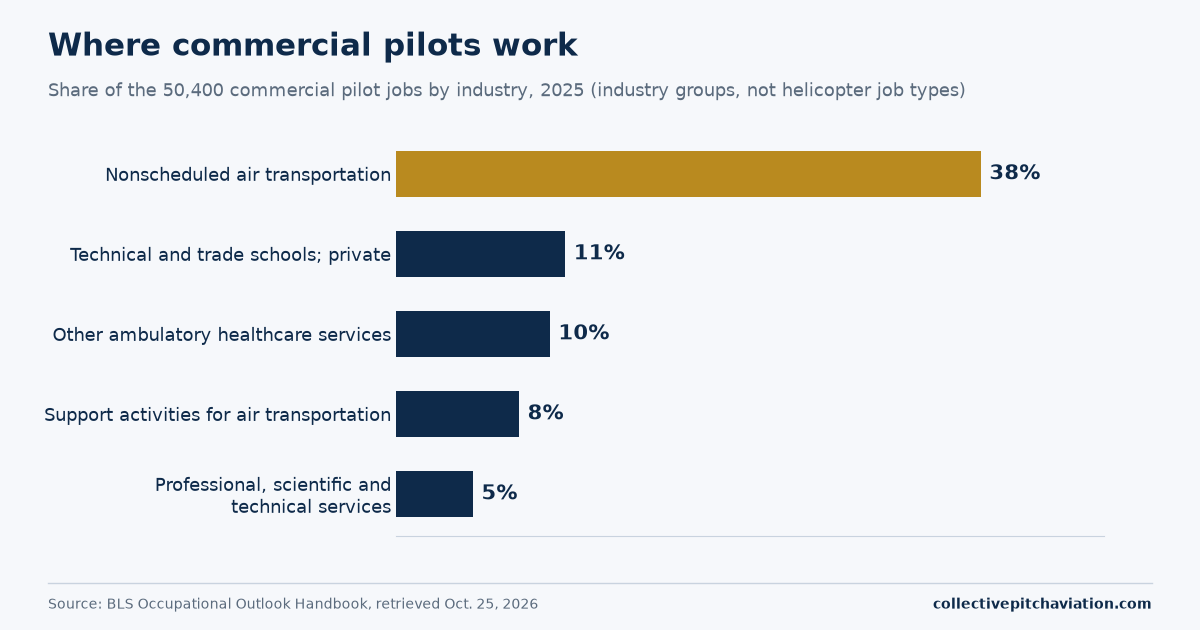
BLS counts commercial pilots, the group that includes most helicopter work, at about 50,400 jobs in 2025 (Occupational Outlook Handbook, retrieved Oct. 25, 2026). The largest employing industries were:
| Industry |
Share of commercial pilot jobs, 2025 |
| Nonscheduled air transportation |
38 percent |
| Technical and trade schools; private |
11 percent |
| Other ambulatory healthcare services |
10 percent |
| Support activities for air transportation |
8 percent |
| Professional, scientific and technical services |
5 percent |
These are industry groupings, not helicopter job types, and BLS does not break out helicopter pilots. For the combined airline and commercial pilot group, BLS projects employment growth of 7 percent from 2025 to 2035, an increase of 11,300 jobs, and about 16,400 openings a year, many from workers who transfer to other occupations or leave the labor force. BLS says commercial pilots may have irregular schedules and that most remain near home overnight, though some work nonstandard hours.
How most pilots enter the market
BLS says some pilots work as flight instructors or on-demand charter pilots, jobs that usually require less experience than airline jobs, to build flying hours. In practice for helicopters, that means the first job is often one of three things: instructing, tour or utility flying, or another entry-level commercial role. Legally, the FAA lets a commercial certificate holder be paid to fly, but a Part 135 pilot in command flying VFR needs 500 hours (14 CFR 135.243(b)), and many employers require more. Our roadmap explains the certificates and our timeline guide explains how to estimate the hour-building time.
The career tracks
1. Flight instructor
What it involves: Teaching students at flight schools and local operators.
How to enter: Commercial certificate with a helicopter rating, then the flight instructor certificate (minimum age 18, 14 CFR 61.183). BLS says the instructor certificate helps pilots build flight time and experience quickly and at less personal expense.
Ask this: Does the school guarantee flying hours? Are instructors paid per hour flown, and what happens in bad weather or slow seasons?
More: Flight school criteria.
2. Air medical (EMS)
What it involves: Flying medical crews and patients between scenes and hospitals. BLS notes that helicopter pilots in rescue operations may fly at low levels in bad weather or at night and land in areas surrounded by obstacles.
How to enter: Employer minimums are high. PHI Air Medical and Metro Aviation each list 2,000 total hours, and PHI also lists 1,000 helicopter pilot-in-command hours and 500 turbine hours (2026). The pilot in command must hold a helicopter instrument rating or an ATP not limited to VFR (14 CFR 135.603).
Ask this: Which hour categories are required (turbine, night, instrument), and can night vision goggle time count toward night?
More: EMS requirements and EMS pay.
3. Tour pilot
What it involves: Scenic and sightseeing flights, often seasonal. BLS lists aerial tours among commercial pilot activities.
How to enter: Commercial certificate and, typically, hours that employers specify. We found no primary source that lists tour employer minimums, so check each operator's current posting.
Ask this: Is pay guaranteed in the off-season? Is housing or relocation covered? How many flights a day are typical?
4. Offshore (oil and gas)
What it involves: Transporting crews to and from offshore platforms on a rotation.
How to enter: We found no primary source with consolidated requirements, so read each operator's current posting.
Ask this: Is pay a salary or a day rate? What is the rotation pattern? How stable is the contract?
5. Law enforcement
What it involves: Aerial support for police and sheriff's agencies.
How to enter: Some roles are held by sworn officers who also fly; others are civilian pilots. Check each posting for whether sworn status is required before building flight hours.
Ask this: Does the role require sworn status? What does the agency's published pay scale and pension look like?
6. Firefighting
What it involves: Water and retardant drops, crew transport and support in wildfire season. BLS lists firefighting among commercial pilot activities.
How to enter: Requirements vary by agency and contractor, and we found no consolidated primary source. Specialized skills such as external load work are common ask-this items.
Ask this: Is the work a seasonal contract, a daily rate, flight-hour pay or a mix? What happens in the off-season?
7. Utility, patrol and aerial work
What it involves: Work such as pipeline or powerline patrol, construction support and other aerial work, which can build pilot-in-command and turbine time and may be seasonal or regional.
How to enter: Employers set the minimums. Read current postings.
Ask this: What types of loads and flying conditions are involved, and what training does the operator provide?
8. Military
What it involves: The Army, Navy, Air Force and Coast Guard train their own helicopter pilots in exchange for a service commitment. Our cost guide summarizes official statements, such as the Army's 10-year commitment for aviation warrant officers after graduation (goarmy.com, retrieved Oct. 25, 2026). Military pilots can apply for civilian certificates under 14 CFR 61.73, with conditions, and BLS notes that military pilots may transfer into civilian aviation. Our guide covers the Army route.
Comparing the tracks
| Track |
Typical entry hours |
Pay information |
Schedule pattern |
| Instructor |
Commercial certificate plus CFI |
BLS context: private technical and trade schools median $93,820 for commercial pilots (May 2025), an industry grouping |
Often hourly, weather-dependent |
| Air medical |
2,000 total hours at two employers reviewed |
Not published on employer pages; see EMS pay |
Commonly extended shifts with days off between |
| Tour |
Not found in primary sources |
Not found |
Often seasonal |
| Offshore |
Not found in primary sources |
Not found |
Rotation-based; confirm with operator |
| Law enforcement |
Varies by agency |
Agency pay scale |
Agency schedule |
| Firefighting |
Varies by agency or contract |
Varies |
Seasonal in many cases |
For the BLS median of $123,220 for commercial pilots overall (May 2025) and other pay context, see the salary guide.
Writing a helicopter pilot resume
Employers in this field screen for flight experience first, so a resume should make the hours easy to read. Use the same categories employers use in postings:
- Certificates and ratings: commercial, instrument, CFI, CFII, ATP if held, with dates.
- Medical: the class you currently hold (do not include medical details).
- Flight time summary: total, helicopter, pilot in command, turbine, night, instrument (actual and simulated), cross-country, and NVG time if any. These match the categories in the EMS employer pages we reviewed.
- Aircraft types flown and hours in each.
- Recent experience: hours in the last 12 months, since some programs ask for it.
- Specialized work: external load, mountain, offshore or other, only if you have done it.
- Training and courses: recurrent, simulator and safety courses.
Keep logbook totals accurate and consistent with your records, because employers verify them. Use a one-page summary of hours with a longer logbook available on request.
How to choose a track
- Pick the job you want in about three to five years, then work backward to its hour minimums.
- Compare the entry job against the pay and schedule you need, using real postings.
- Check how stable the employer or contract is.
- Estimate your hour-building time with the formula in our timeline guide.
- Compare the total training cost with realistic early-career pay.
Looking for current openings? See who's hiring helicopter pilots for employers by sector with their published minimum hours, required certificates and careers pages, and published employer pay scales for what employers state about pay.
Frequently asked questions
What jobs can a helicopter pilot get?
Common tracks include flight instruction, air medical, tours, offshore transport, law enforcement support, firefighting, utility and aerial work, and military service. Requirements and pay vary by employer.
What is the easiest helicopter pilot job to get into?
No source ranks job types by difficulty. BLS says flight instructing and on-demand charter jobs usually require less experience than airline jobs, and many pilots use them to build hours.
Are helicopter pilots in demand?
BLS projects 7 percent growth for airline and commercial pilots combined from 2025 to 2035, much faster than the average for all occupations, with about 16,400 openings a year. That is not a helicopter-specific forecast, and local demand varies.
How many hours do you need for a helicopter pilot job?
It depends on the job. The legal minimum for a Part 135 VFR pilot in command is 500 hours (14 CFR 135.243(b)), and PHI Air Medical and Metro Aviation list 2,000 total hours for air-medical pilots (2026).
Do law enforcement helicopter pilots need to be police officers?
Some roles require sworn status and others do not. Check each agency's posting.
Do you need a degree for a helicopter pilot job?
BLS says commercial pilots typically complete flight training and that some employers require or prefer a degree. Read the posting.
Sources
- U.S. Bureau of Labor Statistics, Occupational Outlook Handbook, "Airline and Commercial Pilots" (2025 employment, May 2025 wages, 2025 to 2035 projections). https://www.bls.gov/ooh/transportation-and-material-moving/airline-and-commercial-pilots.htm. Retrieved October 25, 2026.
- U.S. Code of Federal Regulations, Title 14, sections 61.73, 61.183, 135.243 and 135.603, eCFR text current as of October 22, 2026. https://www.ecfr.gov/current/title-14. Retrieved October 25, 2026.
- PHI Air Medical, Pilot Careers (2026). https://www.phiairmedical.com/career-opportunities/pilots/. Retrieved October 25, 2026.
- Metro Aviation, Metro Pilots (2026). https://choosemetro.metroaviation.com/pilots/. Retrieved October 25, 2026.
- U.S. Army, Army Aviation careers. https://www.goarmy.com/careers-and-jobs/specialty-careers/aviation. Retrieved October 25, 2026.
Disclosure: this page may show ads. See our advertising and affiliate disclosure. This is general information, not career advice.