The two routes
The Army lists separate requirements for warrant officer and commissioned officer aviators (goarmy.com, Army Aviation, retrieved Oct. 25, 2026).
|
Warrant officer aviator |
Commissioned officer aviator |
| Citizenship |
U.S. citizen or permanent resident with a valid Green Card |
U.S. citizen by the time of commissioning |
| Age |
18 to 33 |
At least 17 but under 31 in the year of commissioning |
| Education |
High school diploma or equivalent |
College graduate by commissioning |
| Other |
Eligible for a Secret security clearance; medically and physically fit; good moral standing |
Background check and questionnaire; medically and physically fit; good moral standing |
One caution: the Army's separate page for the aviation officer specialty may list a different age range than the aviation overview page. Treat the numbers above as a starting point and ask a recruiter for the current standard that applies to you.
Our warrant officer guide covers the most common route, flight training for warrant officer candidates, in more detail.
What the Army says about the aircraft
Depending on specialty, the Army says pilots could fly helicopters including the UH-60 Black Hawk, the CH-47 Chinook and the AH-64 Apache, or fixed-wing aircraft such as the C-12 Huron (goarmy.com, Army Aviation, retrieved Oct. 25, 2026). Aircraft assignment is not something an applicant can simply request. Ask the recruiter how assignments are decided and how often a preference is honored.
Selection requirements to expect
The Army's general aviation page lists the basics above. A more detailed list comes from a state Army National Guard recruiting page for aviation warrant officers (South Carolina Army National Guard, retrieved Oct. 25, 2026). It lists:
- A minimum score of 110 on the ASVAB General Technology (GT) area.
- A qualifying score of 40 on the Selection Instrument for Flight Training (SIFT).
- A Class 1A flight physical examination.
- Visual acuity of 20/50 distance vision correctable to 20/20, and 20/20 near vision.
- A Secret security clearance before appointment as a warrant officer.
- No alternates on the physical fitness test events, plus height and weight standards.
That page describes the National Guard process. Active-duty requirements and cutoff scores can differ and can change, so use the list to prepare questions rather than as a final checklist. The Army's own aviation FAQ describes successful candidates as motivated, diligent and responsible, with strong visual and spatial skills, stable health and good judgment (goarmy.com, Army Aviation, retrieved Oct. 25, 2026).
Training: what the pipeline looks like
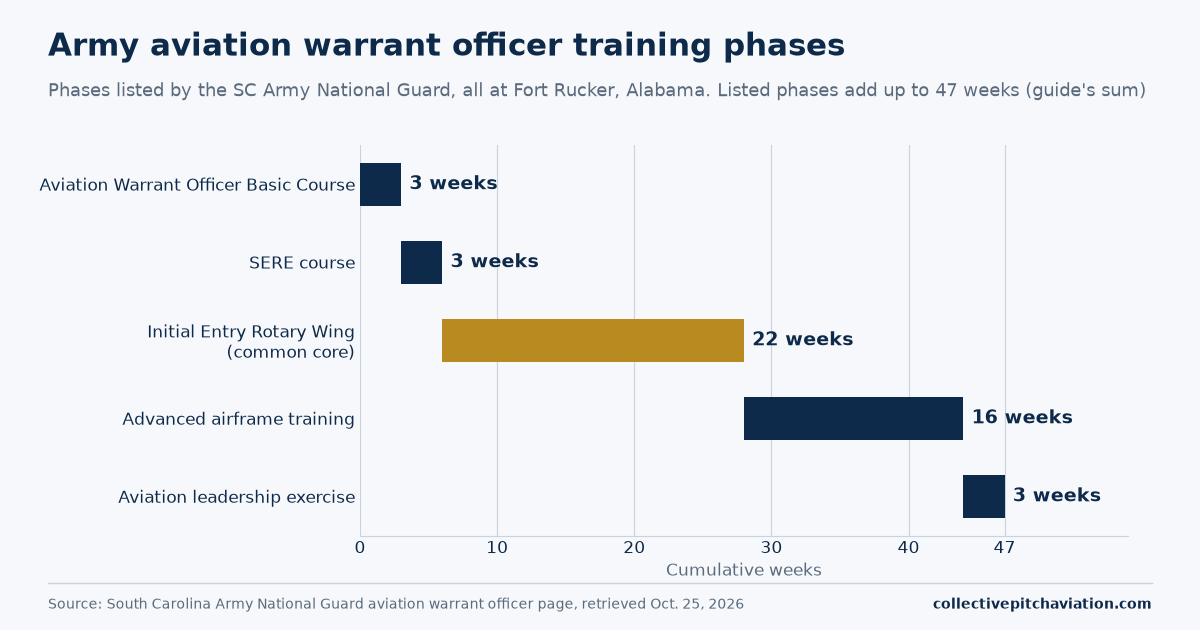
The National Guard page lists these phases, all at Fort Rucker, Alabama (South Carolina Army National Guard, retrieved Oct. 25, 2026):
| Phase |
Length listed |
| Aviation Warrant Officer Basic Course |
3 weeks |
| Survival, Evasion, Resistance and Escape (SERE) course |
3 weeks |
| Initial Entry Rotary Wing flight training, common core |
22 weeks |
| Advanced airframe training |
16 weeks |
| Aviation leadership exercise |
3 weeks |
Adding the listed phases gives 47 weeks (our sum, not a figure quoted by the Army). That total leaves out the time to apply, wait for a selection board and reach the first class, so the elapsed time from first call to pilot wings is longer. Ask a recruiter how long applicants in your area typically wait.
For how military flying may convert to civilian certificates, see the section on moving to civilian flying below.
The service commitment
The Army says aviation warrant officers commit to 10 years of service after they graduate (goarmy.com, Army Aviation, retrieved Oct. 25, 2026). The National Guard page says the 10-year obligation for Guard members began on October 1, 2020, and runs concurrently with, not in addition to, other obligations. Commitments differ by component and program and can be changed by policy.
Ask this: Does the commitment start at graduation or at enlistment? Does it run on active duty, in the Guard or in the Reserve? What happens if I do not complete flight school? Get the answers in the enlistment paperwork, not just in conversation.
Pay and benefits
The Army says warrant officer pilots start with a base salary between $39,000 and $54,000 with less than two years of Army experience, and that warrant officers with eight years of experience earn up to $69,000 a year in base pay (goarmy.com, Army Aviation, retrieved Oct. 25, 2026). The Army adds that base pay is one part of total compensation, which includes health care, housing allowances, flight pay and other benefits. A different Army page for warrant officers generally gives a slightly different starting range of $40,000 to $56,000 (goarmy.com, Warrant Officers, retrieved Oct. 25, 2026), another reason to check current pay tables.
The Army also says that while civilian jobs may pay higher baseline salaries, military pay includes benefits that add up (goarmy.com, Army aviation warrant officer page, retrieved Oct. 25, 2026). For civilian pilot pay context, see our salary guide. Compare equal things: base pay versus base pay, or total compensation versus total compensation.
Army training versus civilian flight school
|
Army route |
Civilian route |
| Tuition |
The Army says flight school is paid for by the Army |
Published school prices vary widely; see our |
| Income during training |
Army salary and benefits (Army statement) |
Usually none; many students borrow (see
) |
| Commitment |
10 years of service after graduation for aviation warrant officers |
None, beyond any loan or school contract |
| Choice of mission and location |
Assigned by the Army; ask how much say you have |
Chosen by you, subject to the job market |
| Selection |
Competitive; entrance tests and medical review |
Open, if you hold the required FAA medical and can pay |
Neither path is automatically better. A person who values flexibility may prefer civilian training, while a person who values paid training and a steady salary may weigh the commitment differently. Neither cost nor time is the only factor.
Moving from military to civilian flying
Military pilots can apply for civilian FAA certificates under 14 CFR 61.73, with conditions. BLS also notes that military pilots may transfer into civilian aviation (Occupational Outlook Handbook, "Airline and Commercial Pilots," retrieved Oct. 25, 2026). The details depend on the military record, so ask an FAA-certificated examiner or flight school about the conversion process before relying on it. Our job tracks guide covers where civilian helicopter pilots work.
How the other branches compare
The Navy, Air Force and Coast Guard also train helicopter pilots, through different pipelines and with different degree requirements. See our Navy and Air Force comparison and the Coast Guard guide. For civilian FAA basics, see helicopter pilot requirements and the full roadmap.
Questions to ask a recruiter
- What are the current age, score and medical standards for the route I want?
- How long is the wait between applying and starting flight school?
- When does my service commitment start, and where can it be served?
- What happens if I do not pass a phase of flight training?
- How are aircraft and duty locations assigned?
- How many of my hours and which training convert to civilian certificates?
Frequently asked questions
Do you need a college degree to be an Army helicopter pilot?
Not for the warrant officer route. The Army says you can qualify with a high school diploma or GED. Commissioned officers must be college graduates by commissioning (goarmy.com, Army Aviation, retrieved Oct. 25, 2026).
How long is the Army commitment for pilots?
The Army says aviation warrant officers commit to 10 years of service after graduating from flight school. Confirm the commitment for your specific component and contract.
How old can you be to start Army flight school?
The Army lists 18 to 33 for warrant officer aviators and at least 17 but under 31 in the year of commissioning for commissioned officers. Another Army page for aviation officers may list a different range, so confirm with a recruiter.
How long is Army flight school?
A National Guard page lists phases that add up to 47 weeks (our sum), not counting selection and waiting time (South Carolina Army National Guard, retrieved Oct. 25, 2026).
Does the Army pay for flight school?
Yes. The Army says flight school is paid for by the Army, and soldiers receive Army pay and benefits during that time (goarmy.com, Army Aviation, retrieved Oct. 25, 2026).
Can Army pilots become civilian helicopter pilots?
Often, with conditions. The FAA allows military pilots to apply for civilian certificates under 14 CFR 61.73. Check the conversion steps with a flight school or examiner.
Sources
- U.S. Army, Army Aviation careers (eligibility, aircraft, commitment, pay ranges, FAQ). https://www.goarmy.com/careers-and-jobs/specialty-careers/aviation. Retrieved October 25, 2026.
- U.S. Army, Warrant Officers (base pay range, aviation direct entry). https://www.goarmy.com/careers-and-jobs/find-your-path/warrant-officers. Retrieved October 25, 2026.
- U.S. Army, Rotary Wing Aviator Warrant Officer 153A (pay comparison FAQ). https://www.goarmy.com/careers-and-jobs/aviation/managing-piloting-aircraft/153a-rotary-wing-aviator-warrant-officer. Retrieved October 25, 2026.
- South Carolina Army National Guard, Aviation Warrant Officer (selection standards, training phases, service obligation). https://nationalguard.com/south-carolina/aviation-warrant-officer. Retrieved October 25, 2026.
- U.S. Bureau of Labor Statistics, Occupational Outlook Handbook, "Airline and Commercial Pilots." https://www.bls.gov/ooh/transportation-and-material-moving/airline-and-commercial-pilots.htm. Retrieved October 25, 2026.
- U.S. Code of Federal Regulations, Title 14, section 61.73, eCFR text current as of October 22, 2026. https://www.ecfr.gov/current/title-14. Retrieved October 25, 2026.
Disclosure: this page may show ads. See our advertising and affiliate disclosure. This site is not affiliated with the U.S. Army or any military branch. This is general information, not career or enlistment advice; speak with an official recruiter.