Last reviewed: October 25, 2026. Facts on this page come from the U.S. Coast Guard's recruiting pages, retrieved on the date shown. This site is not affiliated with the Coast Guard or any military branch. Where the official pages do not state a figure, such as the length of the service commitment or the age limit, this guide says so and lists what to ask.
The Coast Guard flies helicopters and airplanes for search and rescue, law enforcement and other missions. Its pilots are military officers, and the routes into the cockpit differ from the Army's. This guide lays out the three entry routes the Coast Guard describes, what flight school looks like, which aircraft pilots go on to fly and what the official pages leave unanswered.
Quick answerThe Coast Guard says it has the highest percentage of officers who are pilots of any U.S. military service. People enter aviation through one of three routes: a Direct Commission Aviation program for people who already have military pilot experience, a general commissioning source such as Officer Candidate School followed by flight school, or a college pre-commissioning program. Flight school is at Naval Air Station Pensacola, Florida, and the Coast Guard says it takes approximately two years to earn wings (gocoastguard.com, Aviation, retrieved Oct. 25, 2026).
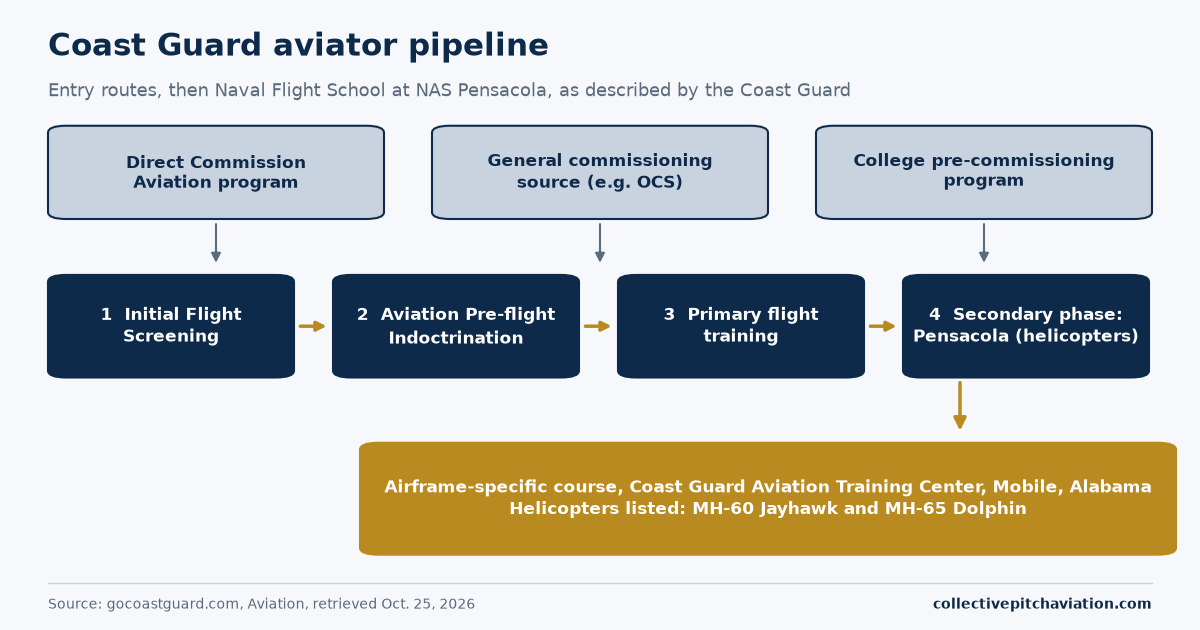
The three entry routes
The Coast Guard describes these paths (gocoastguard.com, Aviation, retrieved Oct. 25, 2026):
| Route |
Who it fits |
What the Coast Guard says |
| Direct Commission Aviation |
People with prior military flight experience as a pilot |
You join and immediately begin flying |
| General commissioning, such as Officer Candidate School (OCS) |
People without military flight experience |
You earn flight school as your first assignment, or apply and are selected for flight school later in your career |
| College Student Pre-Commissioning Initiative (CSPI) |
CSPI officer trainees |
You can enter flight school through the Wilkes Flight Initiative |
The Coast Guard's eligibility page lists separate requirement sets for each program, including OCS, CSPI and Direct Commission Aviator (gocoastguard.com, Eligibility Requirements, retrieved Oct. 25, 2026). The details, such as degree and age requirements, were not available in the page text we reviewed, so confirm them with a Coast Guard recruiter before planning around them.
Ask this: Which program matches my education and experience? If I choose OCS, how are flight school seats awarded, and how often do first-assignment seats go to new officers?
Fitness and entry standards
The eligibility page states that all new Coast Guard members, officer and enlisted, are expected to perform a set of fitness standards. They include pushups in one minute (males 29, females 15), a timed forearm plank (males 1:18, females 1:09) and a timed 1.5-mile run (males 12:29, females 15:05). Boot camp and OCS both include swim training, and the Coast Guard says candidates who are uncomfortable in the water may benefit from strengthening their abilities before arrival (gocoastguard.com, Eligibility Requirements, retrieved Oct. 25, 2026). The Coast Guard also says its Recruiting Command can authorize case-by-case waivers to certain entrance standards for otherwise strong candidates, determined through your recruiter.
These are entry standards for all members, not the standards for flight school or the flight physical. The pages reviewed do not list aviator medical standards, so ask a recruiter for them in writing.
Flight school
When selected for flight school, the Coast Guard says you attend Naval Flight School at Naval Air Station Pensacola, Florida. It lists these stages (gocoastguard.com, Aviation, retrieved Oct. 25, 2026):
- Initial Flight Screening. You become familiar with flying and confirm it is a fit.
- Aviation Pre-flight Indoctrination. You learn basic aerodynamics, aviation weather, air navigation, flight rules and regulations, aircraft engines and systems, and how flight affects the human body.
- Primary flight training. Extensive training in simulators and aircraft. Depending on your interests and available opportunities, you are assigned to either the fixed-wing or the helicopter subspecialty.
- Secondary phase. In Pensacola for helicopters, or Corpus Christi, Texas, for fixed-wing aircraft.
The page states that earning wings takes approximately two years. Because the Coast Guard sends students to Naval Flight School, the Navy's description of its own pipeline (see our Navy and Air Force comparison) may overlap with some of these stages. Confirm with a recruiter.
After you earn your wings
After wings, pilots are assigned to an air station and attend an airframe-specific course at the Coast Guard Aviation Training Center in Mobile, Alabama. The helicopters listed are the MH-60 Jayhawk and the MH-65 Dolphin. The fixed-wing aircraft listed are the HC-130 Hercules and HC-144 Ocean Sentry. Pilots return once a year for a one-week proficiency course in their airframe (gocoastguard.com, Aviation, retrieved Oct. 25, 2026).
The career ladder
The Coast Guard says you can expect to gain initial experience as a co-pilot and eventually earn the title of aircraft commander. Throughout an aviation career you may fly search and rescue, law enforcement and other missions, and with leadership and operational skills you may be selected for command of an air station. The Coast Guard also says aviators are encouraged to apply for sponsored graduate programs, including aeronautical engineering and aviation safety systems (gocoastguard.com, Aviation, retrieved Oct. 25, 2026).
The page describes the work as flying in challenging, high-risk environments, such as rescuing people in distress, stopping smugglers and monitoring illegal activities. This site does not rate any branch's mission or working conditions; use official pages and conversations with recruiters to decide whether the work fits you.
What the official pages did not say
Three things readers often want were not stated on the pages we reviewed, so this guide does not give numbers for them:
- The length of the service commitment after flight school. Ask a recruiter for the current obligation and get it in writing. For comparison, the Air Force states 10 years of active duty after pilot training, and the Army states 10 years for aviation warrant officers; see Army and our Navy and Air Force comparison.
- Age limits for the aviation routes. Ask a recruiter for the current limit for the program you want.
- Pay. Officer pay depends on rank, time in service and allowances. Ask for current pay tables, and compare like with like.
Coast Guard versus the civilian route
|
Coast Guard |
Civilian |
| Training cost |
Flight school is part of military service; no tuition is listed on the pages reviewed |
Published school prices vary widely; see training cost |
| Time to wings or certificates |
About two years to wings (Coast Guard statement) |
Depends on schedule; see the roadmap |
| Aircraft |
MH-60 Jayhawk, MH-65 Dolphin |
Training helicopters, then the aircraft your employer flies |
| Selection |
By program; see the Coast Guard eligibility page |
Open if you meet FAA rules; see requirements |
Civilian training is paid for by the student unless the student finds funding; see financing. After service, military pilots may apply for civilian FAA certificates under 14 CFR 61.73, with conditions, and BLS notes that military pilots may transfer into civilian aviation (Occupational Outlook Handbook, retrieved Oct. 25, 2026). See civilian job tracks for where those pilots work.
Questions to ask a recruiter
- Which entry route fits my background, and what are its current degree, age and medical requirements?
- How are flight school seats awarded, and what is the wait?
- What is the service commitment after flight school, and how does it start?
- How are helicopter and fixed-wing tracks decided?
- Which air stations take new aviators, and how are they assigned?
- What flight training or hours convert to FAA certificates?
Frequently asked questions
Can you become a Coast Guard pilot without military experience?
Yes, according to the Coast Guard, through a general commissioning source such as Officer Candidate School, then flight school as a first assignment or later in a career (gocoastguard.com, Aviation, retrieved Oct. 25, 2026).
Where is Coast Guard flight school?
Naval Air Station Pensacola, Florida, for initial training, with the helicopter secondary phase also in Pensacola.
How long does it take to become a Coast Guard helicopter pilot?
The Coast Guard says it takes approximately two years to earn wings, followed by an airframe-specific course at the Aviation Training Center in Mobile, Alabama.
What helicopters does the Coast Guard fly?
The Coast Guard lists the MH-60 Jayhawk and the MH-65 Dolphin.
Does the Coast Guard have more pilots than the other services?
The Coast Guard says it has the highest percentage of officers who are pilots of any U.S. military service. That is a percentage, not a count.
Is the Coast Guard commitment 10 years?
The pages reviewed do not state it. Ask a recruiter for the obligation that applies to your program and put it in writing.
Sources
- U.S. Coast Guard, Aviation (officer careers). https://www.gocoastguard.com/careers/officer/aviation. Retrieved October 25, 2026.
- U.S. Coast Guard, Eligibility Requirements. https://www.gocoastguard.com/get-started/eligibility-requirements. Retrieved October 25, 2026.
- U.S. Bureau of Labor Statistics, Occupational Outlook Handbook, "Airline and Commercial Pilots." https://www.bls.gov/ooh/transportation-and-material-moving/airline-and-commercial-pilots.htm. Retrieved October 25, 2026.
- U.S. Code of Federal Regulations, Title 14, section 61.73, eCFR text current as of October 22, 2026. https://www.ecfr.gov/current/title-14. Retrieved October 25, 2026.
- U.S. Air Force, Pilot (service commitment, used for comparison). https://www.airforce.com/careers/aviation-and-flight/pilot/pilot. Retrieved October 25, 2026.
- U.S. Army, Army Aviation careers (service commitment, used for comparison). https://www.goarmy.com/careers-and-jobs/specialty-careers/aviation. Retrieved October 25, 2026.
Disclosure: this page may show ads. See our advertising and affiliate disclosure. This site is not affiliated with the U.S. Coast Guard or any military branch. This is general information, not career or enlistment advice; speak with an official recruiter.