Requirements at a glance
| Requirement |
FAA or federal rule |
Where it comes from |
| Student pilot minimum age |
16 |
14 CFR 61.83 |
| Private pilot minimum age (helicopter) |
17 |
14 CFR 61.103 |
| Commercial pilot minimum age |
18 |
14 CFR 61.123 |
| Flight instructor minimum age |
18 |
14 CFR 61.183 |
| English |
Read, speak, write and understand English |
14 CFR 61.83 and 61.103 |
| Medical, student and private |
At least third class |
14 CFR 61.23(a)(3) |
| Medical, commercial |
At least second class |
14 CFR 61.23(a)(2) |
| Education |
None found in the sections reviewed |
14 CFR 61.83, 61.103, 61.123 |
| Non-citizen flight training |
TSA security vetting rule applies |
49 CFR Part 1552 |
For the full certificate sequence, see our roadmap.
Age
The FAA minimums are 16 for a student pilot certificate, 17 for a private certificate in a rating other than glider or balloon, and 18 for a commercial pilot certificate or flight instructor certificate (14 CFR 61.83, 61.103, 61.123 and 61.183). In the Part 61 sections we reviewed, we found no maximum age for holding or earning these certificates. Age does affect the medical certificate's duration, described below.
Military routes set their own age limits. For example, the Army lists 18 to 33 for aviation warrant officers (goarmy.com, retrieved Oct. 25, 2026), and the Air Force requires that you begin pilot training between age 18 and your 33rd birthday (airforce.com, retrieved Oct. 25, 2026). See our Army guide.
English language
An applicant for a private pilot certificate must be able to read, speak, write and understand English. If an applicant cannot meet one of these because of a medical reason, the FAA may place operating limitations on the certificate (14 CFR 61.103(c)). Student pilot certificate rules include the same English requirement (14 CFR 61.83).
FAA medical certificate
The FAA requires at least a third-class medical certificate to exercise student and private pilot privileges, and at least a second-class medical certificate to exercise commercial pilot privileges (14 CFR 61.23(a)(2) and (a)(3)). First class is required for airline transport pilot privileges in certain operations.
How long a medical lasts
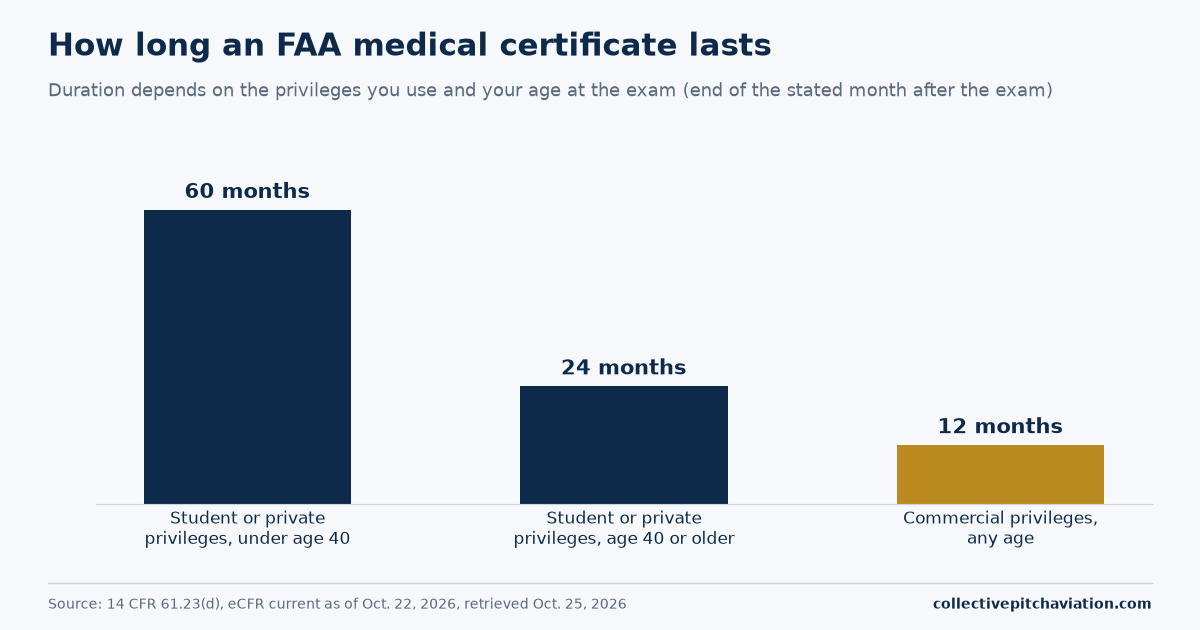
Duration depends on the privileges and your age at the exam (14 CFR 61.23(d)):
| Privileges |
Your age at the exam |
Medical certificate expires for that use |
| Student, private or flight instructor privileges (third class, second class or first class) |
Under 40 |
End of the 60th month after the exam month |
| Student, private or flight instructor privileges |
40 or older |
End of the 24th month after the exam month |
| Commercial privileges (second or first class) |
Any age |
End of the 12th month after the exam month |
A medical that has lapsed for commercial privileges can still be valid for private privileges, because the expiration depends on what you are doing. The regulation includes more detailed rules for other operations, so read the section if your plans are unusual.
How to get one
The FAA's process, as published on its medical certification pages (retrieved Oct. 25, 2026):
- Create an account in MedXPress and submit the application.
- Print or save the confirmation, because the examiner needs the confirmation number.
- Complete the exam with an Aviation Medical Examiner (AME) within 60 days of submitting the application.
- Find an AME through the FAA's Designee Locator, or ask pilot groups or local flight schools for recommendations.
The FAA says an AME is a physician with specific training in how to perform FAA exams. If you have a current or past medical condition or take medications, the FAA recommends reading the Guide for Aviation Medical Examiners beforehand and says that, for some conditions, the FAA may require a recent clinical progress note from your treating physician, dated no more than 90 days before the exam. In some cases the AME can issue a certificate immediately if you bring the right documents; without them, certification may be delayed.
This site does not list disqualifying conditions or predict outcomes. Medical decisions belong to the FAA and your AME. Ask this: What documents should I bring for my history? What is your fee? Exam fees vary by examiner (Quantum Helicopters estimates about $175, Jan. 1, 2026), so call a few before booking. Get the medical before paying for lessons.
Education
The Part 61 sections for the student, private and commercial certificates that we reviewed list no education requirement. BLS says commercial pilots typically complete flight training, and some employers require or prefer a bachelor's degree (Occupational Outlook Handbook, "Airline and Commercial Pilots," retrieved Oct. 25, 2026). Military routes differ: the Army says aviation warrant officers can qualify with a high school diploma or GED, while the Navy and the Air Force list a bachelor's degree as a requirement for their pilots (goarmy.com, navy.com and airforce.com, retrieved Oct. 25, 2026). See Navy vs. Air Force.
Citizenship and non-U.S. citizens
The FAA sections reviewed for the private and commercial certificates (14 CFR 61.103 and 61.123) do not set a citizenship requirement. Separately, the TSA's rule at 49 CFR Part 1552 applies to non-U.S. citizens who apply for flight training, and to the flight training providers who train them. TSA calls its oversight program the Flight Training Security Program. The rule defines discovery flights as demonstration flights for marketing purposes (49 CFR 1552.3), which is one reason schools may handle discovery flights and enrolled training differently. Rules and exemptions are detailed, and military pilots and others can follow different paths.
Ask this: Does the school have experience enrolling non-U.S. citizens, how long does the TSA process take, and what must be completed before the first lesson? Hillsboro Aero Academy, for example, notes that limitations apply to non-U.S. citizens for logbook entries from discovery flights (2025 blog post), and lists a separate international application processing fee (effective Nov. 1, 2026).
Hours and experience
FAA minimums are floors. Private helicopter: 40 hours. Commercial helicopter: 150 hours, with 50 in helicopters and 35 hours as pilot in command in helicopters (14 CFR 61.109(c) and 61.129(c)). The FAA says most people need 60 to 75 hours for a private certificate, a general figure (FAA, Pilot Schools Information, retrieved Oct. 25, 2026). See how long it takes and the training stages guide.
Employers set higher bars. PHI Air Medical and Metro Aviation each list 2,000 total hours for air-medical pilots (2026), and the FAA requires a helicopter instrument rating for air ambulance pilots in command (14 CFR 135.603). The FAA minimum for a Part 135 pilot in command flying VFR is 500 hours (14 CFR 135.243(b)). See the EMS guide and job tracks.
Requirements by stage
| Stage |
Key requirements |
| Before lessons |
Medical certificate; English; meet age minimum for the certificate you want |
| Student pilot |
Age 16 or older; instructor knowledge test and proficiency check before first solo (14 CFR 61.83 and 61.87) |
| Private |
Age 17; 40 hours minimum; knowledge test and checkride |
| Commercial |
Age 18; second-class medical; 150 hours minimum; knowledge test and checkride |
| First jobs |
Employer hours, usually far above FAA minimums |
Costs that come with requirements
Meeting requirements has costs such as medical exams, knowledge tests and checkrides. For published examples, see training cost.
Frequently asked questions
What are the requirements to become a helicopter pilot?
Be at least 16 for a student certificate, 17 for private and 18 for commercial, read and speak English, hold the right FAA medical certificate, log the required hours and pass the knowledge and practical tests. Employers add hours and ratings.
What FAA medical do you need?
At least third class for student and private flying, and at least second class for commercial flying (14 CFR 61.23(a)).
Is there an age limit for helicopter pilots?
We found no maximum age in the Part 61 sections reviewed. Your medical certificate lasts for shorter periods after age 40 for private privileges, and military and employer programs set their own limits.
Do you need a college degree?
Not for the FAA certificates. BLS says some employers require or prefer a degree.
Can non-U.S. citizens train to be helicopter pilots in the U.S.?
A TSA rule, 49 CFR Part 1552, applies to non-U.S. citizens who apply for flight training. Ask the school how it works for you.
Do you need a pilot's license for airplanes first?
No. Helicopter certificates are separate rotorcraft certificates.
Sources
- U.S. Code of Federal Regulations, Title 14, Part 61, sections 61.23, 61.83, 61.87, 61.103, 61.109, 61.123, 61.129 and 61.183, and Part 135, sections 135.243 and 135.603, eCFR text current as of October 22, 2026. https://www.ecfr.gov/current/title-14. Retrieved October 25, 2026.
- U.S. Code of Federal Regulations, Title 49, Part 1552 (Flight Training Security Program), eCFR text current as of October 22, 2026. https://www.ecfr.gov/current/title-49. Retrieved October 25, 2026.
- Federal Aviation Administration, How do I get a Medical Certificate. https://www.faa.gov/pilots/medical_certification/get. Retrieved October 25, 2026.
- Federal Aviation Administration, Pilot Schools Information. https://www.faa.gov/training_testing/training/pilot_schools. Retrieved October 25, 2026.
- U.S. Bureau of Labor Statistics, Occupational Outlook Handbook, "Airline and Commercial Pilots." https://www.bls.gov/ooh/transportation-and-material-moving/airline-and-commercial-pilots.htm. Retrieved October 25, 2026.
- Quantum Helicopters, Tuition and Other Estimated Fees, prices effective Jan. 1, 2026. https://www.quantumhelicopters.com/tuition-and-other-estimated-fees/. Retrieved October 25, 2026.
- Hillsboro Aero Academy, Helicopter Rental Rates and Fees (effective Nov. 1, 2026). https://flyhaa.com/helicopter-rates/ ; and "What Is a Discovery Flight?" (Sept. 4, 2025). https://blog.flyhaa.com/blog/what-is-a-discovery-flight. Retrieved October 25, 2026.
- PHI Air Medical, Pilot Careers (2026). https://www.phiairmedical.com/career-opportunities/pilots/. Retrieved October 25, 2026.
- Metro Aviation, Metro Pilots (2026). https://choosemetro.metroaviation.com/pilots/. Retrieved October 25, 2026.
- U.S. Army, Army Aviation careers; U.S. Navy, Helicopter Pilot; U.S. Air Force, Pilot. https://www.goarmy.com/careers-and-jobs/specialty-careers/aviation ; https://www.navy.com/careers-benefits/careers/aviation/helicopter-pilot ; https://www.airforce.com/careers/aviation-and-flight/pilot/pilot. Retrieved October 25, 2026.
Disclosure: this page may contain ads and affiliate links to study materials or medical exam preparation guides. See our advertising and affiliate disclosure. This is general information, not medical, legal or flight-training advice.