Last reviewed: October 25, 2026. Timing figures come from the FAA's regulations, the FAA's own statements on training time, and schools' published durations, each dated. No source gives one honest number for the whole journey, so this guide breaks it into stages and shows what controls each.
How long it takes depends less on the calendar than on how often you fly, how many hours employers ask for, and whether you can find a job that provides those hours. This guide separates the training stage, which can be planned fairly closely, from the hour-building stage, which cannot.
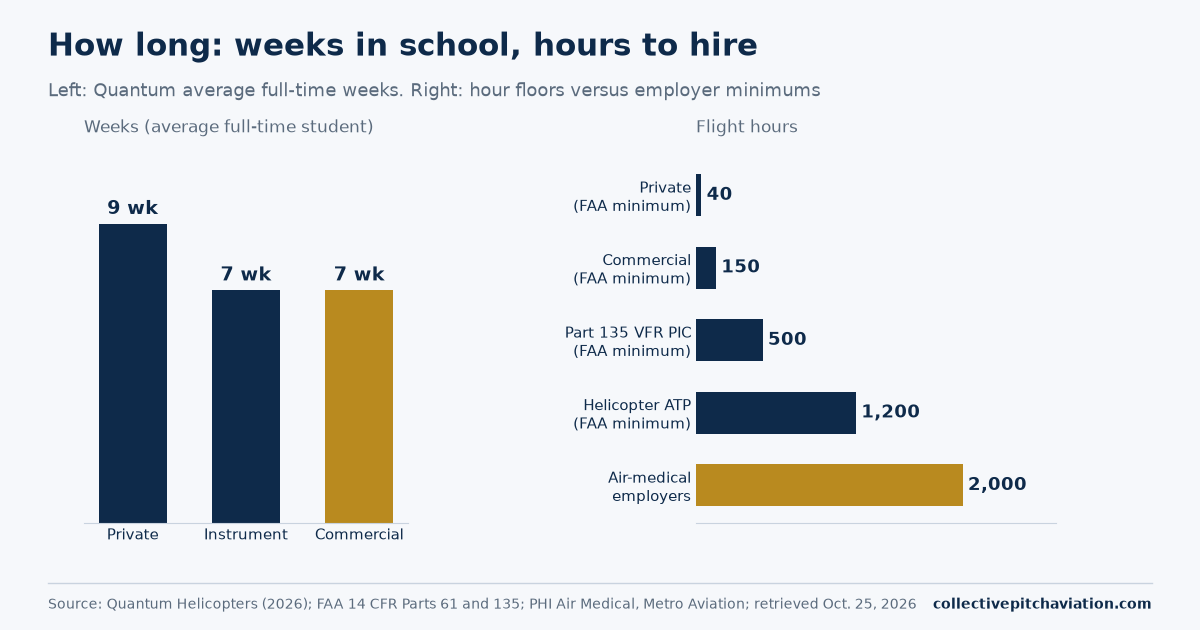
Quick answerTraining to a commercial helicopter certificate is measured in months on a full-time schedule and longer if you fly part-time, according to the schools that publish durations. Reaching the hours many employers ask for takes additional time that depends on the job you can get and how much it lets you fly. Quantum Helicopters publishes average full-time completion times of 9 weeks for the private certificate, 7 for the instrument rating and 7 for the commercial certificate (2026). The FAA says most people need 60 to 75 hours of training for a private certificate against a 40-hour minimum (retrieved Oct. 25, 2026; a general figure, not helicopter-specific). Employers such as PHI Air Medical and Metro Aviation list 2,000 total hours for air-medical pilots (2026).
The two stages that set your timeline
- Training stage. Medical, student certificate, private, instrument, commercial and instructor certificates. The pace is controlled mostly by your schedule, budget, weather and aircraft availability.
- Hour-building stage. Accumulating the flight time employers require. The pace is controlled mostly by the job you hold and the hours it provides.
Our roadmap explains each certificate. This guide focuses on time.
What FAA minimums say, and why they understate the time
The FAA sets minimum flight hours for each helicopter certificate (14 CFR Part 61, eCFR text current as of Oct. 22, 2026):
| Certificate or rating |
Minimum |
Regulation |
| Private pilot, helicopter |
40 hours |
61.109(c) |
| Instrument-helicopter rating |
40 hours of instrument time, plus 50 hours of cross-country as pilot in command |
61.65(e) |
| Commercial pilot, helicopter |
150 hours total flight time |
61.129(c) |
| Airline transport pilot, helicopter |
1,200 hours total |
61.161 |
These are floors. The FAA says most people need 60 to 75 hours for a private certificate (FAA, Pilot Schools Information). Quantum Helicopters lists average student hours above the FAA minimums, for example 70 dual and 10 solo hours for the private certificate, against a 40-hour dual minimum (2026). Ask any school for its average hours, not the minimum.
Two timing rules also matter. A knowledge test must be passed within the 24 calendar months before the month of the practical test (14 CFR 61.39(a)(1)). A second-class medical used for commercial privileges expires at the end of the 12th month after the exam (14 CFR 61.23(d)). Long gaps in training can mean retaking tests or repeating medicals.
Timeline 1: Full-time civilian school
Full-time programs pack training into consecutive weeks. Published durations include:
- Quantum Helicopters (Arizona), average full-time completion: private 9 weeks, instrument 7 weeks, commercial 7 weeks (2026). Adding the three published figures gives 23 weeks (our sum, not quoted by the school).
- Pelican Flight Training (Florida): 3 to 4 months for the private course and 2 to 3 months for the commercial course, and an 18-month Professional Program H from private through CFII (page undated, retrieved Oct. 25, 2026).
Differences between schools show how much depends on assumptions, such as pace, weather and whether the instrument rating is included. After the commercial certificate, a flight instructor certificate is usually the next step. Training for it adds time that these figures do not include.
What lengthens a full-time timeline: bad weather, aircraft downtime, instructor changes, a failed checkride, and time spent waiting for a designated examiner. Ask each school what share of lessons are lost to weather and how checkride scheduling works.
Timeline 2: Part-time at a local operator
Part-time training spreads lessons over months or years around work. It can reduce the amount you must borrow at once, but a lower flying frequency can mean more total hours to reach the same proficiency. We do not quote a numeric difference because no primary source we found measures it. Ask the operator:
- How many lessons per week do students on a similar schedule typically fly?
- What is the average number of hours to each certificate?
- How is a break of several weeks handled, and does it change the price?
Timeline 3: Military
Military training follows each branch's pipeline, and the time to complete it is set by the service. The cost is a service commitment: the Army says aviation warrant officers commit to 10 years of service after graduating, and the Air Force says its pilots serve 10 years of active duty after pilot training (goarmy.com and airforce.com, retrieved Oct. 25, 2026). Selection is competitive and you do not choose the mission. Under 14 CFR 61.73, military pilots may apply for civilian certificates based on military qualifications, with conditions. Ask an official recruiter for current timelines and commitments in writing; this site is not affiliated with any military branch.
The stage nobody can predict: hour building
After the commercial certificate you need hours. The 150-hour commercial minimum is far below the 2,000 total hours PHI Air Medical and Metro Aviation list for air-medical pilots (2026), and the FAA minimum for a Part 135 VFR pilot in command is 500 hours (14 CFR 135.243(b)). BLS says some pilots work as flight instructors or on-demand charter pilots to build flying hours (Occupational Outlook Handbook, retrieved Oct. 25, 2026).
How to estimate your own number
Use this formula with figures from a current job posting:
Months to target = (employer's hour minimum - your current hours) / hours you realistically fly per month
The inputs that decide the answer are the hours per month, which depends on the job, and the season. As an illustration only, using the 2,000-hour employer minimum above and the 150-hour commercial minimum as a starting point, the gap is 1,850 hours. At 40, 60 or 80 hours a month the formula gives about 46, 31 or 23 months. Those monthly rates are what-if inputs chosen for the arithmetic, not typical figures. Many instructors fly far fewer hours in slow seasons, and tour and seasonal jobs have off-seasons. Ask each prospective employer how many hours pilots typically log and whether hours are guaranteed.
To compare the hour minimums employers publish, see who's hiring helicopter pilots, which lists each employer's stated minimums, required certificates and careers page.
Factors that stretch or shorten any timeline
- Flying frequency. Frequent lessons usually mean less relearning between sessions.
- Weather and season. Regions differ in flyable days.
- Money. Running out of funds mid-program is a common cause of delay. See what it costs.
- Medical and checkride results. Failed or delayed tests add time.
- Job market. Hour-building roles may be seasonal or scarce. See job tracks.
- School quality. Aircraft availability and instructor turnover affect progress. Use the school criteria.
Frequently asked questions
How long does it take to get a helicopter pilot license?
Published full-time durations for the private certificate range from 9 weeks (Quantum Helicopters, average full-time student, 2026) to 3 to 4 months (Pelican Flight Training). Part-time schedules take longer. The FAA minimum is 40 hours, but most people need more.
How long does it take to become a commercial helicopter pilot?
Quantum Helicopters lists average full-time durations of 9, 7 and 7 weeks for the private, instrument and commercial courses (2026). Pelican Flight Training describes an 18-month program from private through CFII. Employers for some jobs then ask for far more hours than the 150-hour minimum.
How long does it take to become an EMS helicopter pilot?
It depends on how you build hours. See our EMS requirements guide for stages and employer minimums.
Can you become a helicopter pilot in a year?
Some full-time programs publish durations under a year to the commercial certificate, but jobs requiring more hours take longer. No source we reviewed guarantees a time to employment.
Does the military take longer?
The length varies by branch and program, and includes a multi-year service commitment. Confirm with an official recruiter.
Sources
- U.S. Code of Federal Regulations, Title 14, Part 61, sections 61.23, 61.39, 61.65, 61.73, 61.109, 61.129 and 61.161, and Part 135, section 135.243, eCFR text current as of October 22, 2026. https://www.ecfr.gov/current/title-14. Retrieved October 25, 2026.
- Federal Aviation Administration, Pilot Schools Information. https://www.faa.gov/training_testing/training/pilot_schools. Retrieved October 25, 2026.
- Quantum Helicopters, Programs/Pricing (average student hours and completion times), 2026. https://www.quantumhelicopters.com/helicopter-training-program-pricing/. Retrieved October 25, 2026.
- Pelican Flight Training, Helicopter Pilot Training (undated). https://pelicanflightschool.com/helicopter-pilot-training. Retrieved October 25, 2026.
- PHI Air Medical, Pilot Careers (2026). https://www.phiairmedical.com/career-opportunities/pilots/. Retrieved October 25, 2026.
- Metro Aviation, Metro Pilots (2026). https://choosemetro.metroaviation.com/pilots/. Retrieved October 25, 2026.
- U.S. Bureau of Labor Statistics, Occupational Outlook Handbook, "Airline and Commercial Pilots." https://www.bls.gov/ooh/transportation-and-material-moving/airline-and-commercial-pilots.htm. Retrieved October 25, 2026.
- U.S. Army, Army Aviation careers. https://www.goarmy.com/careers-and-jobs/specialty-careers/aviation. Retrieved October 25, 2026.
- U.S. Air Force, Pilot. https://www.airforce.com/careers/aviation-and-flight/pilot/pilot. Retrieved October 25, 2026.
Disclosure: this page may contain ads and affiliate links to study materials, and may offer a timeline planner in exchange for an email address. See our disclosure(/advertising-and-affiliate-disclosure/). This is general information, not career or flight-training advice.