What carries over
AOPA's flight training writer says that when a pilot learns helicopters, communications, navigation and airport operations transfer, "but that's pretty much it," and that almost everything else in training feels new (AOPA Pilot, "Flight Training: Rotorhead," Aug. 1, 2021). Other items are not about flying skill at all:
- The pilot certificate and medical. The add-on goes on the existing certificate. The existing medical class still governs the privileges used (14 CFR 61.23; see requirements).
- No new knowledge test for the category add-on. 14 CFR 61.63(b)(4) says no additional knowledge test is needed when the applicant already holds an airplane, rotorcraft, powered-lift or other listed rating at that certificate level. The school or instructor still has to endorse the applicant as competent in the aeronautical knowledge areas (61.63(b)(2)).
- Reduced hours at some stages, not zero. The hour rules below still require specific time "in helicopters."
- An instrument rating does not transfer by itself. The instrument-helicopter rating has its own experience rule, 14 CFR 61.65(e): 50 hours of cross-country time as pilot in command (10 in a helicopter) and 40 hours of actual or simulated instrument time, 15 of them with an instructor who holds an instrument-helicopter rating, plus a 100 nautical mile IFR cross-country with three kinds of approaches. Ask a school how an existing airplane instrument rating is treated in its program.
Add-on rating requirements: what the regulation says
The category add-on rule (14 CFR 61.63(b))
An applicant who adds a category rating to a pilot certificate:
- Must complete the training and have the applicable aeronautical experience.
- Must have a logbook or training record endorsement from an authorized instructor attesting that the person was found competent in the appropriate aeronautical knowledge areas and proficient in the appropriate areas of operation.
- Must pass the practical test.
- Need not take an additional knowledge test, if the applicant holds an airplane, rotorcraft, powered-lift, weight-shift-control aircraft, powered parachute or airship rating at that pilot certificate level.
The regulation does not spell out a separate, smaller hour table for add-ons. The phrase "applicable aeronautical experience" points to the experience rule for the certificate level sought. That is why AOPA directs readers to 61.109(c) for the private level.
Private pilot, helicopter: 14 CFR 61.109(c)
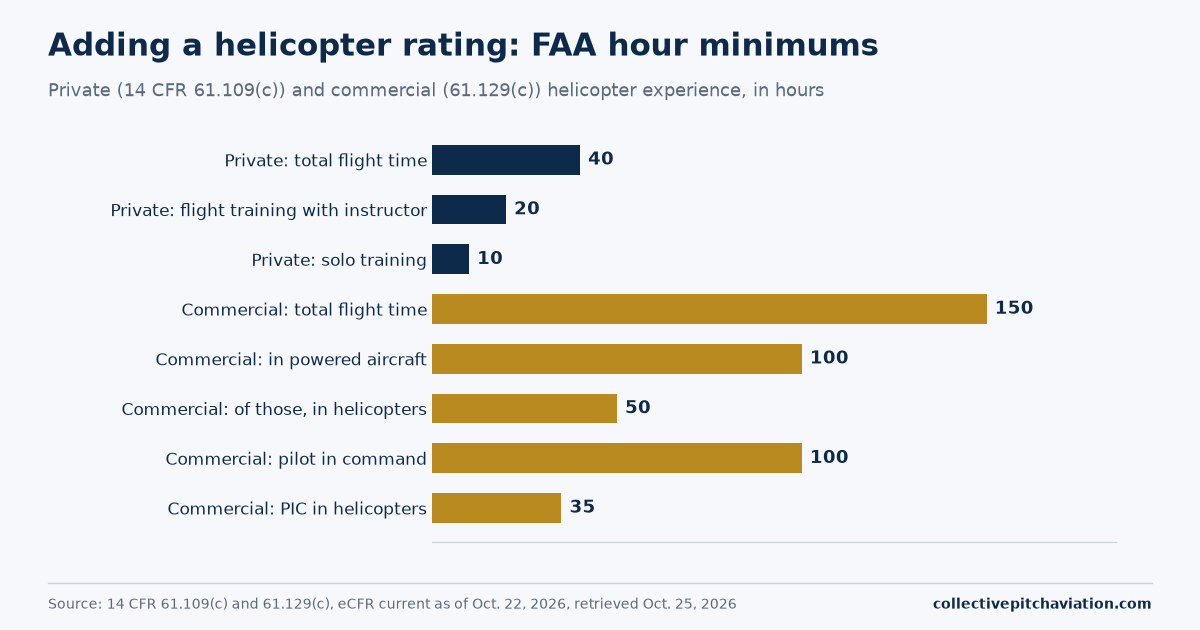
The rule requires at least 40 hours of flight time that includes at least 20 hours of flight training from an authorized instructor and 10 hours of solo flight training, and the training must include at least:
- 3 hours of cross-country flight training in a helicopter;
- 3 hours of night flight training in a helicopter, including one cross-country flight of over 50 nautical miles and 10 takeoffs and 10 landings to a full stop;
- 3 hours of flight training with an authorized instructor in a helicopter in preparation for the practical test, within the preceding 2 calendar months;
- 10 hours of solo flight time in a helicopter, including 3 hours of cross-country time and one solo cross-country flight of 100 nautical miles total distance with landings at three points, one segment more than 25 nautical miles between takeoff and landing locations.
AOPA adds that a Robinson R22 student must complete training required by SFAR 73, including 20 hours of dual before first solo, so Robinson students can expect "a minimum of 30 flight hours" before the checkride (AOPA Pilot, Aug. 1, 2021). The FAA regulation sets minimums, not typical totals.
Commercial pilot, helicopter: 14 CFR 61.129(c)
For a commercial certificate with a rotorcraft category and helicopter class rating, the applicant must log at least 150 hours of flight time as a pilot, consisting of at least:
- 100 hours in powered aircraft, of which 50 must be in helicopters;
- 100 hours of pilot-in-command time, including at least 35 hours in helicopters and 10 hours of cross-country flight in helicopters;
- 20 hours of training on the areas of operation in 61.127(b)(3), including at least 5 hours of instrument control by reference to instruments (aircraft, simulator or training device), one 2-hour day cross-country flight and one 2-hour night cross-country flight in a helicopter, each more than 50 nautical miles from the departure point, and 3 hours in a helicopter with an authorized instructor in preparation for the test within the preceding 2 calendar months;
- 10 hours of solo flight in a helicopter (or 10 hours as pilot in command with an instructor on board), including one cross-country with landings at a minimum of three points and a segment of at least 50 nautical miles, and 5 hours of night VFR with 10 takeoffs and 10 landings in the traffic pattern.
Simulator credit is limited. 14 CFR 61.129(i) lets an applicant who did not train in a Part 142 course credit a maximum of 25 hours toward the helicopter experience requirements from a full flight simulator or flight training device representing a helicopter, and a Part 142 course allows more (61.129(i)(2)).
A commercial airplane pilot usually already has the 150 total hours. The helicopter-specific lines (50 hours in helicopters, 35 as PIC in helicopters, 10 cross-country in helicopters) are the ones that have to be logged in a helicopter. Whether a school counts time toward them in a particular way is a question for the school and the examiner who will give the checkride.
Published rates and typical add-on cost
Use only the published numbers below. Totals depend on the school, the aircraft and how many hours a student needs.
| Item |
Rate or price |
Source and date |
| Robinson R22 rental |
$350 an hour |
Hillsboro Aero Academy, effective Nov. 1, 2026 |
| Flight instruction (helicopter sheet) |
$65 an hour |
Hillsboro Aero Academy, effective Nov. 1, 2026 |
| Robinson R44 rental |
$570 an hour |
Hillsboro Aero Academy, effective Nov. 1, 2026 |
| R22 with instructor ("dual") |
$395 an hour |
Quantum Helicopters, effective Jan. 1, 2026 |
| R44 dual |
$695 an hour |
Quantum Helicopters, effective Jan. 1, 2026 |
| Turbine R66 |
$1,595 an hour |
Quantum Helicopters, effective Jan. 1, 2026 |
| Checkride examiner fee |
$900 to $1,200 per checkride |
Quantum Helicopters, effective Jan. 1, 2026 |
| Private helicopter add-on, school estimate |
About 30 to 40 hours; $18,950 including aircraft, fuel, instructor and checkride |
Pelican Flight Training add-on page (Schweizer 300C), undated |
| Commercial helicopter add-on, school estimate |
About 40 to 50 hours; price "Contact for quote" |
Pelican Flight Training add-on page, undated |
Pelican's add-on page uses hour ranges it calls typical averages. The same page lists a full private helicopter program for beginners at the same $18,950, so the page does not show a lower price for add-on students at the private level. Ask for the add-on price in writing.
Our arithmetic (illustration, not a quote): Hillsboro's R22 plus instruction is $350 + $65 = $415 an hour. Thirty hours at $415 is $12,450. Thirty hours at Quantum's $395 dual rate is $11,850; Quantum prices solo time at its $350 rental rate, so that total would be lower in practice. Thirty hours is the AOPA figure for a Robinson private checkride, not a promise. Both totals leave out ground instruction, checkride fees, tax and fuel surcharges. For a full price-by-price breakdown, see helicopter lessons cost and training cost.
For context, Hillsboro lists the Cessna 152 at $167 an hour and the Cessna 172 at $221 (airplane rates, effective Nov. 1, 2026), against $350 for the R22. Helicopter hours cost more per hour at the one school that publishes both.
What catches airplane pilots
The FAA Helicopter Flying Handbook (FAA-H-8083-21B, 2019) is the standard reference. The points below restate its chapters in plain words.
Three controls instead of two
The handbook names three major controls: the collective pitch control, the cyclic pitch control, and the antitorque pedals, plus a throttle that is usually on the collective (Chapter 3). The collective changes the pitch of all main rotor blades together. Raising it increases blade pitch and drag, so rotor rpm drops unless power is added; governors or correlators help but may still need adjustment. The cyclic tilts the rotor disk to give direction of travel. The pedals control tail rotor thrust and hover heading. An airplane pilot's habits for rudder, yoke and throttle do not map onto this.
Hovering
The handbook says "Hovering is the most challenging part of flying a helicopter," because a helicopter generates its own gusty air in a hover, which calls for constant small control inputs (Chapter 2). It also warns that overcontrolling is common.
Autorotation
The handbook defines autorotation as the state of flight where the main rotor disk is turned by air moving up through the rotor rather than by engine power (Chapter 2). AOPA notes that for many students the first autorotation is initiated lower than 500 feet above the ground and that the power rolls off while the student must respond immediately (AOPA Pilot, Aug. 1, 2021).
Weight, balance and loading
Lateral center of gravity matters in ways that airplane training does not stress. In the handbook's dynamic rollover discussion, one of the conditions listed as most critical for helicopters with counterclockwise rotor rotation is a right lateral center of gravity. In slope operations it notes that lateral cyclic requirements change when passengers or cargo are loaded or unloaded (Chapter 11). For weight and balance basics, the handbook points readers to FAA-H-8083-1, Weight and Balance Handbook.
Dynamic rollover
The handbook says dynamic rollover needs three factors: a rolling moment, a pivot point other than the helicopter's normal center of gravity, and thrust greater than weight. Once started, opposite cyclic alone cannot stop it, and quickly reducing collective is the most effective way to stop it from developing (Chapter 11).
Mast bumping and low G
The handbook describes mast bumping as the result of excessive rotor flapping in semirigid rotor systems, with a static stop contacting the mast. It also warns that helicopters rely on positive G for control response and that a low-G condition "can be catastrophic" for two-bladed teetering rotor helicopters, so abrupt forward cyclic inputs must be avoided (Chapters 4 and 11).
Vortex ring state
The handbook describes vortex ring state (formerly settling with power), a descent condition that can be entered during many maneuvers and has its own recovery procedure (Chapter 11). Airplane training has no equivalent.
Risk culture
AOPA's writer says helicopter pilots operate with different assumptions, such as flying low below cloud decks and counting fuel reserves in minutes, and that this can make an airplane pilot question risk habits (AOPA Pilot, Aug. 1, 2021). Read the safety numbers in helicopter crash statistics with that in mind.
Employers that value fixed-wing time
Only one employer in this research states in its own text that both airplane and helicopter pilots are in scope.
- U.S. Customs and Border Protection, Air and Marine Operations (Air Interdiction Agent). The announcement accepts applicants who are "dual rated" (airplane with instrument rating and rotorcraft helicopter with instrument rating), airplane rated or helicopter rated. It sets 1,500 flight hours at entry on duty, with up to 500 waivable, plus 250 PIC, 75 instrument and 75 night hours, and notes that AMO is currently prioritizing the placement of commercial rotary-wing certificate holders and best-qualified fixed-wing pilots (USAJOBS announcement AIA 27-01 13051330, open October 1 to 31, 2026).
Air Methods and Metro Aviation each publish fixed-wing pilot requirements alongside rotor-wing ones on their pilot pages, which shows they operate both, but neither page says fixed-wing time counts toward rotor-wing minimums. The rotor-wing minimums at Air Methods, PHI Air Medical and Metro Aviation are written in helicopter or category hours (see who's hiring). Plan to build time in a helicopter for most helicopter jobs.
Further reading
Frequently asked questions
Do airplane pilots need a new written test for a helicopter rating?
Not for the category add-on. 14 CFR 61.63(b)(4) says no additional knowledge test is needed if the applicant holds an airplane, rotorcraft, powered-lift or other listed rating at that certificate level. A flight instructor endorsement and a practical test are still required.
How many hours does a helicopter add-on take?
The regulation sets minimums that include time in helicopters, for example the 40-hour private rule in 61.109(c) and the 150-hour commercial rule in 61.129(c). AOPA says a Robinson private checkride needs at least about 30 flight hours because of SFAR 73. One school estimates 30 to 40 hours for a private add-on. Actual hours vary by student.
What does a helicopter add-on cost?
Published rates include $350 an hour for an R22 at Hillsboro Aero Academy and $395 an hour with an instructor at Quantum Helicopters. One school lists $18,950 for a private helicopter add-on of about 30 to 40 hours. This site's illustrative arithmetic for 30 hours is $11,850 to $12,450 before ground, checkride and tax.
Does your airplane instrument rating work in a helicopter?
Not automatically. The instrument-helicopter rating has its own experience rule in 14 CFR 61.65(e). Ask a school how it handles an existing airplane instrument rating.
Do employers count airplane time toward helicopter minimums?
Published rotor-wing minimums are written in helicopter or category hours. The CBP announcement is the one source in this research that accepts airplane, helicopter or dual-rated pilots.
Sources
- U.S. Code of Federal Regulations, Title 14, sections 61.23, 61.63, 61.65, 61.109 and 61.129, eCFR text current as of October 22, 2026. https://www.ecfr.gov/current/title-14/chapter-I/subchapter-D/part-61. Retrieved October 25, 2026.
- Federal Aviation Administration, Helicopter Flying Handbook, FAA-H-8083-21B (2019), chapters 2, 3, 4, 10 and 11. https://www.faa.gov/regulations_policies/handbooks_manuals/aviation/helicopter_flying_handbook. Retrieved October 25, 2026.
- AOPA, Ian J. Twombly, "Flight Training: Rotorhead," AOPA Pilot, August 1, 2021. https://www.aopa.org/news-and-media/all-news/2021/august/pilot/flight-training-rotorhead. Retrieved October 25, 2026.
- AOPA, Other Ratings and Endorsements. https://www.aopa.org/training-and-safety/active-pilots/ratings-and-endorsements/other-ratings. Retrieved October 25, 2026.
- Hillsboro Aero Academy, Helicopter Rental Rates and Fees, prices effective Nov. 1, 2026. https://flyhaa.com/helicopter-rates/. Retrieved October 25, 2026.
- Hillsboro Aero Academy, Airplane Rates and Fees, prices effective Nov. 1, 2026. https://flyhaa.com/airplane-rates/. Retrieved October 25, 2026.
- Quantum Helicopters, Tuition and Other Estimated Fees, prices effective Jan. 1, 2026. https://www.quantumhelicopters.com/tuition-and-other-estimated-fees/. Retrieved October 25, 2026.
- Pelican Flight Training, Add a Helicopter Rating to Your Pilot License (undated). https://pelicanflightschool.com/add-a-helicopter-rating-to-your-pilot-license. Retrieved October 25, 2026.
- U.S. Customs and Border Protection, Air Interdiction Agent, USAJOBS announcement AIA 27-01 13051330. https://www.usajobs.gov/job/886512600. Retrieved October 25, 2026.
- Air Methods, Pilot Careers. https://www.airmethods.com/roles-at-air-methods/pilots/. Retrieved October 25, 2026.
- Metro Aviation, Metro Pilots. https://choosemetro.metroaviation.com/pilots/. Retrieved October 25, 2026.
- PHI Air Medical, Pilot Careers. https://www.phiairmedical.com/career-opportunities/pilots/. Retrieved October 25, 2026.
Disclosure: this page may contain ads and links. Sponsored items are always labeled. See our disclosure(/advertising-and-affiliate-disclosure/). This is general information, not career, legal or financial advice.