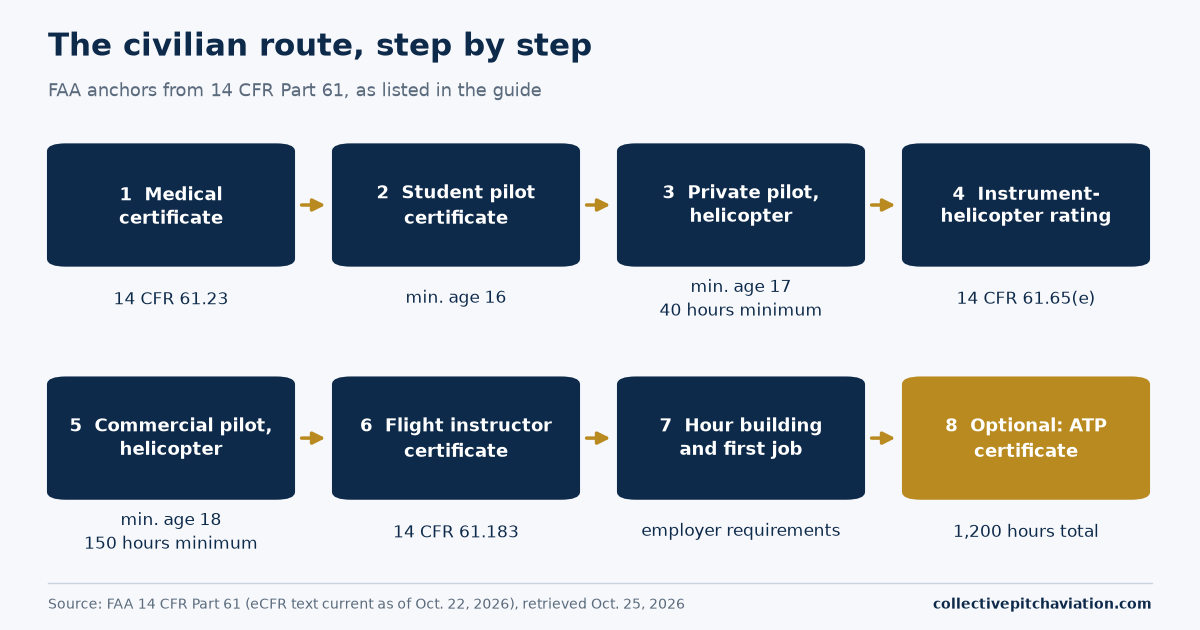
The roadmap at a glance
| Step |
What you earn |
FAA anchor (14 CFR Part 61) |
| 1 |
Medical certificate |
61.23 |
| 2 |
Student pilot certificate |
61.83 (minimum age 16) |
| 3 |
Private pilot certificate, helicopter |
61.103 and 61.109(c) (minimum age 17; 40 hours minimum) |
| 4 |
Instrument-helicopter rating |
61.65(e) |
| 5 |
Commercial pilot certificate, helicopter |
61.123 and 61.129(c) (minimum age 18; 150 hours minimum) |
| 6 |
Flight instructor certificate |
61.183 |
| 7 |
Hour building and first job |
Employer requirements |
| 8 |
Optional: airline transport pilot (ATP) certificate |
61.161 (1,200 hours total) |
BLS lists the usual order for professional pilots as student certificate, private certificate, instrument rating, commercial certificate, multi-engine rating and ATP certificate, with each certificate requiring a knowledge test and a practical flying exam, commonly called a checkride (Occupational Outlook Handbook, Airline and Commercial Pilots, retrieved Oct. 25, 2026). The multi-engine step in that list applies to airplanes; helicopter pilots add type-specific training for the aircraft they fly.
Step 1: Confirm you can hold a medical certificate
Do this before spending on lessons. The FAA requires at least a third-class medical certificate to exercise student and private pilot privileges, and at least a second-class medical to exercise commercial privileges (14 CFR 61.23(a)(2) and (a)(3)). For commercial privileges a second-class medical expires at the end of the 12th month after the exam (61.23(d)).
Medical rules and disqualifying conditions are set by the FAA, and this site does not give medical advice. If you have any health concern, consult an FAA-designated Aviation Medical Examiner (AME) before committing money to training. Exam fees vary by examiner, so call a few and ask what they charge.
Step 2: Take a discovery flight and choose a path
A discovery flight is a short introductory lesson. It costs money and proves nothing about aptitude, but it shows whether you want to continue. Ask the operator what the flight includes and whether the price counts toward later training. Our discovery flight guide covers them in detail.
At this point, decide between three broad routes:
- Civilian flight school or local operator. Covered below and in our school comparison.
- College aviation program. Flight training inside a degree. Ask for an itemized estimate covering tuition, flight fees and housing.
- Military. The Army, Navy, Air Force and Coast Guard each train helicopter pilots. The cost is a service commitment, which differs by branch and program. Our cost guide summarizes official statements, and our guide covers the Army route.
Step 3: Student pilot certificate
To be eligible you must be at least 16 and able to read, speak, write and understand English (14 CFR 61.83). Before your first solo flight, your instructor must give you a knowledge test on regulations, local airspace and the flight characteristics of the helicopter you fly, and must judge your proficiency in the required maneuvers (61.87).
Step 4: Private pilot certificate, helicopter
The requirements (14 CFR 61.103 and 61.109(c)) include:
- Minimum age 17.
- A logbook endorsement from your instructor, then a passed knowledge test.
- At least 40 hours of flight time, including 20 hours of training with an instructor and 10 hours solo.
- At least 3 hours of cross-country training, 3 hours of night training, and 3 hours of test preparation within the 2 calendar months before the practical test.
- A passed practical test (checkride).
The 40 hours is a floor. The FAA says most people need 60 to 75 hours of training for a private certificate (FAA, Pilot Schools Information, retrieved Oct. 25, 2026; a general figure, not helicopter-specific). Ask any school for the average hours its students actually take.
Step 5: Instrument-helicopter rating
The rating requires 50 hours of cross-country time as pilot in command, 10 of them in a helicopter, and 40 hours of actual or simulated instrument time, 15 of them with an instrument-rated helicopter instructor (14 CFR 61.65(e)). It is optional under the regulations for many jobs, but it is required for helicopter air ambulance pilots in command (14 CFR 135.603), and employers for other roles often prefer it.
Step 6: Commercial pilot certificate, helicopter
This is the certificate that lets you be paid to fly. Under 14 CFR 61.123 and 61.129(c) you must:
- Be at least 18.
- Hold at least a private certificate.
- Log at least 150 hours as a pilot, including 100 in powered aircraft (50 in helicopters) and 100 hours of pilot-in-command time (35 in helicopters).
- Complete 20 hours of training that includes 5 hours of instrument training, a daytime and a nighttime cross-country flight of more than 50 nautical miles, and 3 hours of test preparation.
- Complete 10 hours of solo or pilot-in-command flight that includes a night segment.
- Pass the knowledge test and the practical test. The knowledge test must be passed within the 24 calendar months before the month of the practical test (61.39(a)(1)).
Hours are the common bottleneck. A school's program may bring you to 150 hours, or you may need to build the remainder yourself.
Step 7: Flight instructor certificate
The FAA requires a commercial or ATP certificate with a helicopter rating, and a minimum age of 18, for the flight instructor certificate (14 CFR 61.183). BLS says many pilots earn the instructor certificate because it helps them build flight time and experience quickly and at less personal expense (Occupational Outlook Handbook, retrieved Oct. 25, 2026). That is why instructing is the most common first job. Pay for it varies widely; see our salary guide.
Step 8: Build hours and get a first job
The legal floor and the hiring floor are far apart. The FAA minimum for a Part 135 pilot in command flying VFR is 500 hours (14 CFR 135.243(b)). Two air-medical employers, PHI Air Medical and Metro Aviation, list 2,000 total hours (2026). Common ways to build hours are instructing, tour or utility flying, charter, and other commercial work. Our job tracks guide covers each, and the timeline guide explains how to estimate the time.
BLS reports that employment of airline and commercial pilots combined is projected to grow 7 percent from 2025 to 2035, with about 16,400 openings a year on average, many of them from workers who transfer to other occupations or leave the labor force (Occupational Outlook Handbook, retrieved Oct. 25, 2026). That is a combined airline and commercial figure, not a helicopter forecast.
Step 9: Optional ATP certificate
The helicopter ATP requires at least 1,200 hours of total time, including 500 cross-country, 100 night and 200 helicopter hours (14 CFR 61.161). Some employers prefer or require it. PHI Air Medical, for example, requires pilots to obtain an ATP within 12 months of starting (2026).
Roadmap mistakes to avoid
- Paying before confirming the medical. Check eligibility first.
- Choosing on hourly rate alone. Compare total itemized cost, fleet availability and instructor stability. Use the school criteria.
- Assuming the commercial certificate leads straight to a good job. It usually leads to hour building.
- Borrowing without a repayment plan. Compare the cost with realistic early-career pay.
Frequently asked questions
How do you become a helicopter pilot?
Earn a medical certificate, then a student, private and commercial pilot certificate with a helicopter rating, usually adding an instrument rating and a flight instructor certificate. Then build hours toward the job you want. The steps above list the FAA requirement for each.
Do you need a college degree to be a helicopter pilot?
BLS says commercial pilots typically complete flight training, and that some employers require or prefer a degree (Occupational Outlook Handbook, retrieved Oct. 25, 2026). Check the postings for the job you want.
How old do you have to be?
The FAA minimum is 16 for a student pilot certificate, 17 for a private certificate and 18 for a commercial certificate (14 CFR 61.83, 61.103 and 61.123).
What is the cheapest way to become a helicopter pilot?
No route is automatically cheapest. Military training carries no tuition but requires service, and civilian prices vary widely. Our cost guide lists published school prices.
Can you become a helicopter pilot without an airplane license?
Yes. The helicopter certificates are separate rotorcraft certificates, and the steps above do not require an airplane certificate.
Sources
- U.S. Code of Federal Regulations, Title 14, Part 61, sections 61.23, 61.39, 61.65, 61.83, 61.87, 61.103, 61.109, 61.123, 61.129, 61.161 and 61.183, and Part 135, sections 135.243 and 135.603, eCFR text current as of October 22, 2026. https://www.ecfr.gov/current/title-14. Retrieved October 25, 2026.
- U.S. Bureau of Labor Statistics, Occupational Outlook Handbook, "Airline and Commercial Pilots" (projections 2025 to 2035). https://www.bls.gov/ooh/transportation-and-material-moving/airline-and-commercial-pilots.htm. Retrieved October 25, 2026.
- Federal Aviation Administration, Pilot Schools Information. https://www.faa.gov/training_testing/training/pilot_schools. Retrieved October 25, 2026.
- PHI Air Medical, Pilot Careers (2026). https://www.phiairmedical.com/career-opportunities/pilots/. Retrieved October 25, 2026.
- Metro Aviation, Metro Pilots (2026). https://choosemetro.metroaviation.com/pilots/. Retrieved October 25, 2026.
Disclosure: this page may contain ads and affiliate links to study materials or courses, and may offer a free roadmap checklist in exchange for an email address. See our disclosure(/advertising-and-affiliate-disclosure/). This is general information, not career, medical or flight-training advice.