Stage 0: Medical and first flight
Before paying for lessons, confirm you can hold the FAA medical certificate: at least third class for student and private privileges and at least second class for commercial privileges (14 CFR 61.23(a)). See requirements. Many people also take a discovery flight at this stage. Then choose a school using the school criteria and ask for an itemized quote; see training cost and lessons cost.
Stage 1: Ground knowledge and the first lessons
A student must be at least 16 for a student pilot certificate and must be able to read, speak, write and understand English (14 CFR 61.83). The FAA's Helicopter Flying Handbook is the free reference text. Its chapters include an introduction to the helicopter, aerodynamics of flight, helicopter flight controls, components and systems, and the rotorcraft flight manual (faa.gov, Helicopter Flying Handbook, retrieved Oct. 25, 2026).
The areas of operation for the helicopter private certificate are listed in the regulations (14 CFR 61.107(b)(3)): preflight preparation, preflight procedures, airport and heliport operations, hovering maneuvers, takeoffs, landings and go-arounds, performance maneuvers, navigation, emergency operations, night operations and postflight procedures. This guide does not give a lesson-by-lesson hour count because schools sequence these areas differently. Ask this: What is the school's syllabus, and how many hours are scheduled for each phase?
If the school flies Robinson helicopters, special training rules apply; see R22 vs. R44.
Stage 2: Pre-solo and first solo
Before a first solo flight, the instructor must give the student a knowledge test on regulations, local airspace and the flight characteristics of the helicopter flown, and must judge the student's proficiency in the required maneuvers (14 CFR 61.87). The FAA also requires logbook endorsements for solo flight. Ask the school how it handles this step, because the timing of the first solo varies by student.
Stage 3: Cross-country, night and test preparation
The FAA requirements for the private helicopter certificate include at least 40 hours of flight time with 20 hours of training with an instructor and 10 hours solo, plus at least 3 hours of cross-country training, 3 hours of night training and 3 hours of test preparation within the 2 calendar months before the practical test (14 CFR 61.109(c)). The student must also pass a knowledge test.
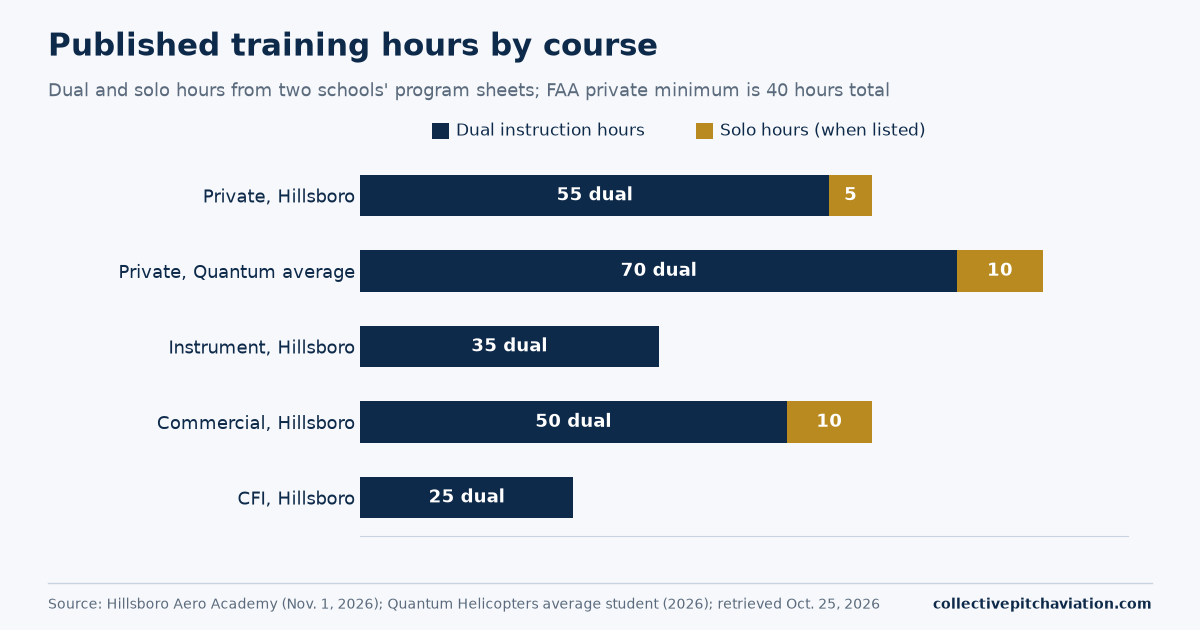
Because the 40 hours is a floor, plan for more. The FAA says most people need 60 to 75 hours of training for a private certificate, a general figure that is not specific to helicopters (FAA, Pilot Schools Information, retrieved Oct. 25, 2026). Quantum Helicopters lists average student hours of 70 dual and 10 solo for the private certificate against the 40-hour minimum (2026).
Stage 4: The private pilot checkride
The practical test is conducted to the FAA's Airman Certification Standards. The FAA publishes separate standards for the private (FAA-S-ACS-15), instrument (FAA-S-ACS-14), commercial (FAA-S-ACS-16) and flight instructor (FAA-S-ACS-29) certificates and ratings for rotorcraft-helicopter (faa.gov, Airman Certification Standards, retrieved Oct. 25, 2026). Students can read the standard for the test they are preparing for and ask their instructor to train to it.
Hillsboro Aero Academy's published sheet lists an examining fee of $500 paid to the school for private, instrument and instructor tests, a computerized FAA written exam at $175 paid to the test provider and a practical exam fee paid to the examiner that varies, listed as $700 to $950 (effective Nov. 1, 2026). Fees at other schools may differ, so ask for them in writing.
Stage 5: Instrument rating
The instrument-helicopter rating requires 50 hours of cross-country time as pilot in command (10 in a helicopter) and 40 hours of actual or simulated instrument time, 15 of them with an instrument-rated helicopter instructor (14 CFR 61.65(e)). The rating is required for helicopter air ambulance pilots in command (14 CFR 135.603), and other employers often prefer it. See the EMS guide.
Hillsboro's published instrument course lists 35 hours of dual in the R22 with instrument equipment, 30 hours of group ground instruction and a practical test (effective Nov. 1, 2026).
Stage 6: Commercial pilot certificate
The commercial helicopter certificate requires the student to be 18, hold at least a private certificate and log at least 150 hours, including 50 in helicopters and 35 as pilot in command in helicopters, plus 20 hours of training including 5 of instrument training, a daytime and a nighttime cross-country flight of more than 50 nautical miles, and 10 hours of solo or pilot-in-command flight with a night segment (14 CFR 61.123 and 61.129(c)). The knowledge test must be passed within the 24 calendar months before the month of the practical test (14 CFR 61.39(a)(1)).
Hillsboro's published commercial course lists 50 hours of dual and 10 hours solo in the R22 (effective Nov. 1, 2026). Hours are often the bottleneck; a school's program may bring you to 150 hours, or you may have to build the rest yourself.
Stage 7: Flight instructor certificate (optional but common)
The FAA requires a commercial or ATP certificate with a helicopter rating and a minimum age of 18 for the flight instructor certificate (14 CFR 61.183). BLS says many pilots earn this certificate because it helps them build flight time and experience quickly and at less personal expense (Occupational Outlook Handbook, retrieved Oct. 25, 2026). Hillsboro lists a CFI course with 25 hours of dual in an R44 and a CFII course with 7 hours of dual in an R22 with instrument equipment (effective Nov. 1, 2026). Its sheet states that totals are averages based on a 200-hour program for the Robinson instructor requirements, that actual costs may vary and that prices are subject to change.
Stage 8: Hour building and the first job
After the commercial certificate, most pilots build hours before an air ambulance or similar role. Employer minimums are far above FAA minimums. PHI Air Medical and Metro Aviation each list 2,000 total hours (2026), and the FAA minimum for a Part 135 pilot in command flying VFR is 500 hours (14 CFR 135.243(b)). See job tracks and the timeline guide.
Program hours at a glance
| Stage |
FAA minimum (helicopter) |
Hillsboro Aero Academy program (effective Nov. 1, 2026) |
Quantum Helicopters average (2026) |
| Private |
40 hours total (14 CFR 61.109(c)) |
55 dual and 5 solo |
70 dual and 10 solo |
| Instrument |
Per 14 CFR 61.65(e) |
35 dual |
Not compared here |
| Commercial |
150 hours total (14 CFR 61.129(c)) |
50 dual and 10 solo |
Not compared here |
| CFI |
Commercial or ATP certificate required |
25 dual |
Not compared here |
Hillsboro notes that program pricing is based on average hours for completion and that individual completion rates vary. These are averages published by schools, not minimums or guarantees.
Keeping a logbook
The FAA requires pilots to document training and aeronautical experience used to meet certificate, rating and flight review requirements (14 CFR 61.51). For each flight or lesson, the logbook must include the date, total flight or lesson time, departure and arrival locations, the aircraft type and identification, and the type of experience, such as solo, pilot in command, second in command and training received from an authorized instructor. It also records conditions of flight, such as day or night, actual instrument and simulated instrument. Instructors also sign endorsements for solo flight, knowledge tests and practical tests.
Keep entries consistent with your records. Employers screen on flight time, and our jobs guide explains how hours are categorized on a resume. A paper logbook or an app can work, as long as it meets 14 CFR 61.51. Apps and paper logbooks vary in price and features, and we found no primary source comparing them, so this guide makes no recommendation.
Questions to ask at each stage
- What does the school's syllabus include, and how are hours measured?
- How do you decide I am ready for solo and for each checkride?
- How many students completed each stage in the school's published average hours?
- What happens if a checkride is not passed on the first attempt, and who pays for re-takes?
- Who is the examiner, and what do their fees include?
- How is weather scheduled around, and how are cancellations handled?
Frequently asked questions
What are the stages of helicopter pilot training?
Medical certificate, student pilot certificate and first lessons, first solo, private certificate, usually an instrument rating, commercial certificate, and often a flight instructor certificate. Hour building follows.
How many hours does it take to get a helicopter license?
The FAA minimum is 40 hours for private and 150 for commercial. The FAA says most people need 60 to 75 hours for a private certificate. Program hours vary by school.
What is a checkride?
It is the practical test, with an oral portion and a flight, given by an examiner to the FAA's standards for the certificate or rating.
How long is a knowledge test good for?
For the commercial certificate, the knowledge test must be passed within the 24 calendar months before the month of the practical test (14 CFR 61.39(a)(1)).
Do you need an instrument rating?
It is optional for many roles but required for helicopter air ambulance pilots in command, and other employers often prefer it.
Do you need to keep a logbook?
Yes. The FAA requires pilots to record training and experience used to meet requirements (14 CFR 61.51).
Sources
- U.S. Code of Federal Regulations, Title 14, Part 61, sections 61.23, 61.39, 61.51, 61.65, 61.83, 61.87, 61.107, 61.109, 61.123, 61.129 and 61.183, and Part 135, sections 135.243 and 135.603, eCFR text current as of October 22, 2026. https://www.ecfr.gov/current/title-14. Retrieved October 25, 2026.
- Federal Aviation Administration, Helicopter Flying Handbook. https://www.faa.gov/regulations_policies/handbooks_manuals/aviation/helicopter_flying_handbook. Retrieved October 25, 2026.
- Federal Aviation Administration, Airman Certification Standards. https://www.faa.gov/training_testing/testing/acs. Retrieved October 25, 2026.
- Federal Aviation Administration, Pilot Schools Information. https://www.faa.gov/training_testing/training/pilot_schools. Retrieved October 25, 2026.
- Hillsboro Aero Academy, Helicopter Rental Rates and Fees (program hours, test fees), prices effective Nov. 1, 2026. https://flyhaa.com/helicopter-rates/. Retrieved October 25, 2026.
- Quantum Helicopters, Programs/Pricing (average student hours), 2026. https://www.quantumhelicopters.com/helicopter-training-program-pricing/. Retrieved October 25, 2026.
- U.S. Bureau of Labor Statistics, Occupational Outlook Handbook, "Airline and Commercial Pilots." https://www.bls.gov/ooh/transportation-and-material-moving/airline-and-commercial-pilots.htm. Retrieved October 25, 2026.
- PHI Air Medical, Pilot Careers (2026). https://www.phiairmedical.com/career-opportunities/pilots/. Retrieved October 25, 2026.
- Metro Aviation, Metro Pilots (2026). https://choosemetro.metroaviation.com/pilots/. Retrieved October 25, 2026.
Disclosure: this page may contain ads, and may promote a paid planner bundle sold by this site after the free tools. See our advertising and affiliate disclosure. This is general information, not flight-training advice; follow your instructor's and the FAA's guidance.