Last reviewed: October 25, 2026. This page restates what air medical operators say on their own careers pages and postings. Employer pages change, and postings are filled or removed. Check each link before acting.
Quick answerAir medical pilots fly patients and medical crews between scenes, clinics and hospitals. The employers read for this page publish minimums that start at 2,000 total flight hours, plus helicopter, pilot-in-command, turbine, night and instrument hours that differ by employer. Air Methods and Global Medical Response publish a 7-days-on, 7-days-off style schedule; the other employers below publish none. Pay figures are published by only some employers; the table in the pay section shows what is on record.
What the job is
Helicopter air ambulance, often called HAA or HEMS, is flying that supports emergency medical care. Employers describe the work as interfacility transports and scene calls, flown day and night. Operators run a mix of company-owned programs and hospital-based programs, so the same job title can differ by base, aircraft and customer contract.
For the legal side, see the plain-language summary in EMS helicopter pilot requirements. That guide covers the FAA rules for air ambulance flying and a staged timeline.
A typical day as employers describe it
This site does not describe a day in its own words. These are the employer descriptions, restated.
- Air Methods says its goal is 24-hour, 365-day coverage and that the top objective for its pilots is safety while providing critical care transports. New hires start with a week of indoctrination training at its Denver headquarters covering topics such as avoiding controlled flight into terrain, inadvertent instrument weather, mountain and high-altitude operations, and brownout and whiteout conditions. Source: Air Methods pilot careers.
- PHI Air Medical describes a 24-hour operation with day and night flights, often using single-pilot instrument flight rules and night vision goggles. It says pilots also take part in community outreach and in its safety management system. The page lists lifting 100 pounds to help load and unload patients and equipment as part of the physical screening. Source: PHI Air Medical pilot careers.
- Air Evac Lifeteam (a Global Medical Response brand) describes training built around the air ambulance flight profile: night flying, hospital rooftop helipads and unimproved rural landing sites such as pastures and fields. It says pilots receive base-specific orientation on local hospitals and obstacles, and simulator training every four months for inadvertent instrument weather. Source: Air Evac Lifeteam aviation page.
- Global Medical Response (GMR) says its helicopter pilots, proficient in both IFR and VFR, conduct air ambulance operations, scene calls and interfacility transports. Source: GMR pilot careers.
- Metro Aviation says it employs pilots to fly for hospital-based programs. Source: Metro Aviation pilots.
Aircraft commonly used
Only aircraft named by the operators are listed.
- GMR lists these rotor-wing types on its pilot page: EC135, EC130, EC145, B206, B407, AS350 and AW119. The page says the fleet has nearly 400 rotor-wing aircraft. Source: GMR pilot careers.
- Air Evac Lifeteam names the Bell 206, Bell 407, and Airbus AS350, EC130 or EC135 in its training program description. Source: Air Evac Lifeteam aviation page.
- Metro Aviation says it operates more than 130 aircraft for over 35 programs, and that most of the fleet is rotorcraft. The pilot page does not name models. Source: Metro Aviation pilots.
- Air Methods and PHI Air Medical: the pilot pages read for this review do not name helicopter models. Air Methods says its entire fleet has been NVG-equipped since 2013 on its company history page. PHI's parent fleet page lists models across all its business lines, so it is not used here as an air medical list.
Published minimums and ratings
All rows were checked on October 25, 2026. "Hours" are as the employer states them.
| Employer |
Minimums as published |
Certificates |
Source |
Date checked |
| Air Methods (rotor-wing VFR) |
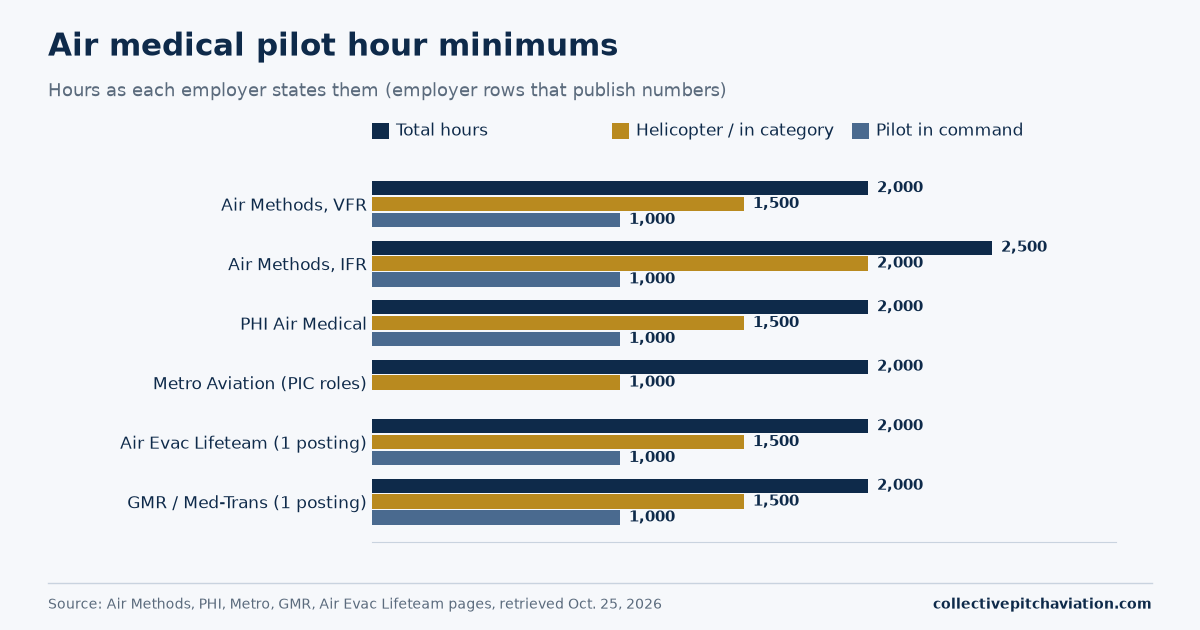
2,000 total, with 1,500 in category; 1,000 PIC in category; 500 rotor-wing turbine; 200 cross-country (50 at night); 100 unaided night as PIC (50 unaided may be replaced by 100 NVG hours, but unaided time cannot go below 50); 50 actual or hood instrument in category |
Commercial and instrument (or ATP) for the category and class; second-class medical (first class may be required for some customer contracts) |
Air Methods |
Oct. 25, 2026 |
| Air Methods (rotor-wing IFR) |
All VFR items plus 2,500 total with 2,000 in category; 1,000 PIC in category; 500 cross-country; 75 actual or simulated instrument (50 in flight, including 20 in actual conditions) |
Same as above |
Air Methods |
Oct. 25, 2026 |
| PHI Air Medical |
2,000 total; 1,500 helicopter; 1,000 helicopter PIC; 500 turbine helicopter; 100 unaided night, or 50 unaided plus 100 NVG; 100 instrument (actual and hood); CAMTS requirement |
Commercial and instrument helicopter ratings (ATP to be obtained within 12 months of starting); first class medical; page also states a 235 pound body weight limit for helicopter candidates |
PHI Air Medical |
Oct. 25, 2026 |
| Metro Aviation |
PIC positions: 2,000 total, 1,000 rotor-wing, 500 cross-country, 100 night (50 unaided); SIC positions: 1,000 total; IFR PIC positions: 75 instrument (50 in flight) |
Commercial rotorcraft and instrument helicopter (ATP rotorcraft preferred); second-class medical (first class at some locations) |
Metro Aviation |
Oct. 25, 2026 |
| Air Evac Lifeteam (one posting, Big Spring, Texas) |
2,000 total; 1,500 helicopter; 1,000 helicopter PIC; 500 turbine helicopter; 100 night unaided, or 50 unaided with 100 aided |
Rotorcraft commercial; helicopter instrument rating; Class II medical |
GMR posting 60733 |
Oct. 25, 2026 |
| GMR / Med-Trans (one posting, Cleveland, Tennessee, IFR, EC145) |
2,000 total; 1,500 helicopter; 1,000 helicopter PIC; 500 turbine helicopter; 100 night unaided, or 50 unaided with 100 aided; 75 helicopter instrument with 50 in aircraft |
Rotorcraft commercial; helicopter instrument rating; Class II medical |
GMR posting 58657 |
Oct. 25, 2026 |
Notes on the table:
- The GMR and Air Evac Lifeteam rows come from single postings and may differ by base, aircraft and brand. The GMR pilot careers page itself publishes no hour figures, and the Air Evac Lifeteam aviation page says only that candidates must meet CAMTS and state requirements.
- Air Methods states a recency rule: a candidate who has not flown in category within the previous 24 months is reviewed by the chief pilot.
- Air Methods describes its minimums as higher than those of other air medical operators. That is the employer's own claim, and this site has not tested it.
Schedule patterns employers publish
- Air Methods: typically a seven-on, seven-off rotation with 12-hour shifts. Annual flight time is typically 200 to 300 hours. Pilots are generally not required to be available on days off but may fill open shifts as overtime.
- GMR: a 7-on, 7-off schedule at most bases, with on-duty housing at most bases. Its fixed-wing page lists other patterns (8/6, 14/14, 14/21), which do not apply to helicopter pilots unless a posting says so.
- Air Evac Lifeteam: the Big Spring posting lists a 7 days on, 7 days off schedule.
- PHI Air Medical and Metro Aviation: no schedule pattern was found on the pages read.
Sources: Air Methods, GMR, PHI Air Medical, Metro Aviation.
Where the bases or operating areas are
Only counts and areas stated on the employer pages are listed.
- Air Evac Lifeteam: says it has more than 150 mutually supporting bases across 15 states.
- PHI Air Medical: says it transports more than 22,000 patients a year from more than 80 bases, including in Arizona, California, Texas and Florida. Its page links to a national base map.
- GMR: says helicopter air ambulance work is conducted across more than sixteen states, with openings including Hawaii and Alaska across fixed and rotor-wing roles.
- Metro Aviation: says it flies for over 35 hospital-based programs and shows example locations such as Orlando, Northern Kentucky, Aurora (Colorado), Madison (Wisconsin), New Bern (North Carolina) and Columbus (Ohio).
- Air Methods: the pilot page reviewed gives no base count. Its company page states more than 100,000 transports and over 150,000 flight hours a year.
Pay data we can source
The full dataset, with every source and date, is on helicopter pilot pay scales. The air medical rows already on that page are restated here.
| Employer |
What is published |
Source |
Date checked |
| Global Medical Response |
A range of $87,019 to $121,997 for rotor-wing air ambulance pilots, described as dependent on experience plus geographic modifiers and base location. Also a $15,000 sign-on bonus and a $40,000, 36-month retention bonus plan. No pay period is stated. |
GMR pilot careers |
Oct. 25, 2026 |
| Air Evac Lifeteam (one posting, Big Spring, Texas) |
$115,387 to $126,926 including a 30% geographic modifier; no pay period stated; $15K sign-on bonus subject to eligibility. |
GMR posting 60733 |
Oct. 25, 2026 |
| Air Methods (one posting, Holyoke, Colorado) |
$82,900 to $93,251 per year, in four steps: $82,900, $86,216, $89,665, $93,251. Also a $25,000 stipend, an experience stipend of up to $12,000 and a $15,000 sign-on bonus. |
Air Methods posting 11032 |
Oct. 25, 2026 |
| PHI Air Medical |
No dollar figure. States pay depends on region, flight time, EMS experience and aircraft-specific hours, and lists shift bonuses and an annual safety bonus. |
PHI Air Medical |
Oct. 25, 2026 |
| Metro Aviation |
No pay figure. Lists a 401(k) match, base modifiers, and a "4% Annual Increase" that the page says is not guaranteed for every employee. |
Metro benefits |
Oct. 25, 2026 |
Other Air Methods postings read the same day showed different stipends by base, and the pilot page says pilots are represented by OPEIU Local 109 and that pay is guided by the union agreement. For context across industries, see the helicopter pilot salary guide and EMS pilot pay.
How to get in
The path below ties the employer minimums to the steps in this site's guides.
- Check medical eligibility first. Employers state second-class, Class II or first-class medicals. See EMS helicopter pilot requirements and speak with an FAA aviation medical examiner before spending on training.
- Earn the certificates. A commercial helicopter certificate and an instrument rating are listed by every employer in the table. See the pilot training overview and the step-by-step roadmap.
- Build hours toward the employer's list. Subtract your hours from the published minimum in each category (total, PIC, turbine, night, instrument). Many pilots use instruction or other commercial flying for this; see how long it takes and the job tracks overview.
- Add the specific hours employers name. Night vision goggle time can replace part of the unaided night requirement at Air Methods and PHI Air Medical, within the limits stated above.
- Apply on the employer site. Air Methods states that only online applications are accepted, and that qualified candidates go through phone and on-site interviews.
- Military route. Military helicopter pilots may qualify differently. See military to civilian helicopter pilot.
Named employers and their careers pages
See also the whole list on who's hiring.
Frequently asked questions
How many hours do air medical helicopter pilots need?
It depends on the employer. The pages read for this review list 2,000 total hours as the starting figure at Air Methods, PHI Air Medical, Metro Aviation (for PIC positions) and the GMR postings. Other hour categories differ, as the minimums table shows.
Do air medical pilots work 7 days on and 7 days off?
Air Methods says its pilots typically work a seven-on, seven-off rotation with 12-hour shifts. GMR says it uses a 7-on, 7-off schedule at most bases. PHI Air Medical and Metro Aviation pages did not state a pattern.
What medical certificate is required?
The employers differ. Air Methods lists second class, with first class possible for some contracts. Metro Aviation lists second class, with first class at some locations. PHI Air Medical lists first class. The GMR postings list Class II.
Does an air medical pilot need an ATP?
Not always. PHI Air Medical requires an ATP to be obtained within 12 months of starting. Metro Aviation prefers one. Air Methods accepts a commercial and instrument rating, or an ATP.
Where do you find current openings?
Use the employer links above. Openings sit on separate applicant sites and change often.
Sources
- Air Methods, Pilot Careers. https://www.airmethods.com/roles-at-air-methods/pilots/. Retrieved October 25, 2026.
- Air Methods, About Us. https://www.airmethods.com/about-us/. Retrieved October 25, 2026.
- Air Methods, pilot posting 11032 (Holyoke, CO). https://pilot-careers-airmethods.icims.com/jobs/11032/helicopter-pilot/job?in_iframe=1. Retrieved October 25, 2026.
- PHI Air Medical, Pilot Careers. https://www.phiairmedical.com/career-opportunities/pilots/. Retrieved October 25, 2026.
- Metro Aviation, Metro Pilots. https://choosemetro.metroaviation.com/pilots/. Retrieved October 25, 2026.
- Metro Aviation, Our Locations. https://choosemetro.metroaviation.com/our-locations/. Retrieved October 25, 2026.
- Metro Aviation, Metro Benefits. https://choosemetro.metroaviation.com/metro-benefits/. Retrieved October 25, 2026.
- Global Medical Response, Pilot Careers. https://careers.gmr.net/pilot-careers. Retrieved October 25, 2026.
- Global Medical Response, posting 60733 (Air Evac Lifeteam, Big Spring, TX). https://careers.gmr.net/event-37989/jobs/60733?lang=en-us and https://careers.gmr.net/event-38714/jobs/60733?lang=en-us. Retrieved October 25, 2026.
- Global Medical Response, posting 58657 (Med-Trans, Cleveland, TN). https://careers.gmr.net/gmr/jobs/58657?lang=en-us. Retrieved October 25, 2026.
- Air Evac Lifeteam, Aviation. https://www.lifeteam.net/about/aviation. Retrieved October 25, 2026.
Disclosure: this page may contain ads and links. Sponsored items are always labeled. See our disclosure(/advertising-and-affiliate-disclosure/). This is general information, not career, legal or financial advice.