What BLS projects
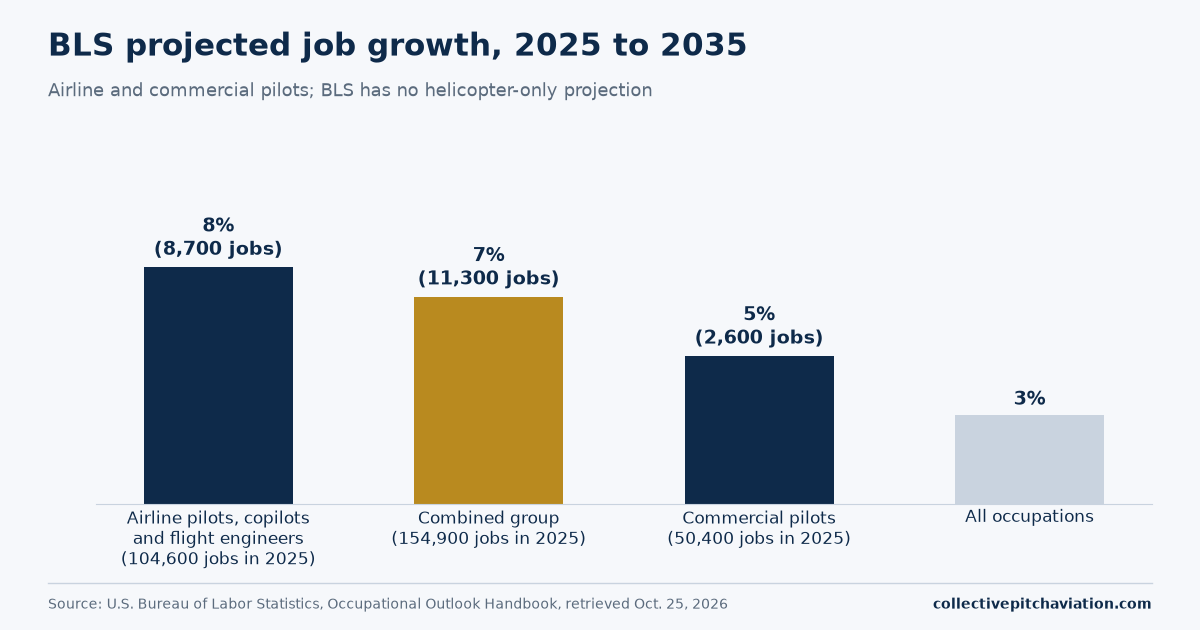
The BLS Occupational Outlook Handbook covers "Airline and Commercial Pilots" (retrieved October 25, 2026). It says these pilots fly airplanes, helicopters and other aircraft. Its main projection figures:
| Group (BLS) |
Jobs, 2025 |
Projected jobs, 2035 |
Change, 2025-35 |
| Aircraft pilots and flight engineers (combined) |
154,900 |
166,300 |
7 percent (11,300 jobs) |
| Airline pilots, copilots and flight engineers |
104,600 |
113,300 |
8 percent (8,700 jobs) |
| Commercial pilots |
50,400 |
53,000 |
5 percent (2,600 jobs) |
| All occupations |
not listed |
not listed |
3 percent |
BLS rounds employment and change to the nearest 100 and percentages to the nearest whole number. It calls the 7 percent combined growth much faster than average. It also projects about 16,400 openings a year for the combined group. It says many of those openings come from workers who move to other occupations or leave the labor force, such as to retire. They are not all new jobs.
For commercial pilots, BLS says continued demand for private chartered flights is expected to sustain job growth. For airline pilots, it points to growing air travel and freight activity.
What BLS says about getting started
BLS notes that commercial pilots typically complete flight training and that some employers require or prefer a degree. It also says some pilots work as flight instructors or on-demand charter pilots to build hours. See how to become a helicopter pilot and helicopter pilot jobs for the steps.
What VAI states about a shortage
VAI is described on its own site as a membership association for the vertical aviation industry. On its Workforce Development page (undated; retrieved October 25, 2026), VAI states that the civilian helicopter industry is experiencing a significant shortage of skilled professionals. VAI also states that in the next 15 years the industry will need more than 7,500 helicopter pilots and more than 40,000 aviation maintenance technicians.
These are VAI's statements. The page does not give a method or a source for the numbers. This site presents them as the organization's claim, not as a fact checked here. The page also says VAI works with industry on recruiting strategy, military transition, job fairs and programs such as the Rotor Pathway Programs. VAI's page does not say whether the 7,500 figure counts new jobs, replacements or both.
URL: https://verticalavi.org/workforce/
This site searched for a comparable statement from Helicopter Association International or the Air Line Pilots Association and found no official page to cite on October 25, 2026. None is used here.
Why the two sources should not be merged
- Different scope. BLS covers all airline and commercial pilots in the United States. VAI's statement is about the civilian helicopter industry. A BLS number cannot be read as a helicopter number.
- BLS groups helicopter pilots with other commercial pilots. The commercial pilot line mixes helicopter, charter, tour, aerial work and other flying. BLS does not break out helicopters.
- Different meaning. BLS counts projected openings and job growth. VAI states a need for pilots over 15 years. They are not the same measure and do not add up.
- Projections are estimates. They describe expected change over ten years, not a guarantee. Actual results can differ.
Limits to keep in mind
- Regional differences. BLS publishes state and area data, and states publish their own projections. National figures can hide local demand.
- Sector differences. Air medical, offshore, tours, utilities, law enforcement and flight instruction each hire differently. See the career guides and who is hiring.
- Experience requirements. Many employers set hour minimums. For example, the Air Methods and PHI Air Medical pilot pages list 2,000 total hours for air-medical pilots. A shortage of experienced pilots is not the same as plentiful entry-level openings.
- Cost and pay. BLS reports a median of $123,220 for commercial pilots in May 2025, with the lowest 10 percent under $58,850. See the salary guide and the cost guide.
Frequently asked questions
Does BLS forecast helicopter pilot jobs?
No. BLS publishes projections for airline and commercial pilots, and helicopter pilots are inside the commercial pilot group.
Is there a helicopter pilot shortage?
VAI states that there is a significant shortage of skilled professionals in the civilian helicopter industry. This site has not verified that claim. Employer hiring pages are a better guide to the roles open to you.
What does 7 percent growth mean?
It is BLS's projected change in combined airline and commercial pilot employment from 2025 to 2035, about 11,300 jobs.
Do 16,400 openings mean 16,400 new jobs?
No. BLS says many openings replace workers who change occupations or leave the labor force.
Sources
- U.S. Bureau of Labor Statistics, Occupational Outlook Handbook, "Airline and Commercial Pilots". https://www.bls.gov/ooh/transportation-and-material-moving/airline-and-commercial-pilots.htm. Retrieved October 25, 2026.
- Vertical Aviation International, Workforce Development. https://verticalavi.org/workforce/. Retrieved October 25, 2026.
- Air Methods, Pilot Careers. https://www.airmethods.com/roles-at-air-methods/pilots/. Retrieved October 25, 2026.
- PHI Air Medical, Pilot Careers. https://www.phiairmedical.com/career-opportunities/pilots/. Retrieved October 25, 2026.
Disclosure: this page may contain ads and links. Sponsored items are always labeled. See our disclosure(/advertising-and-affiliate-disclosure/). This is general information, not career, legal or financial advice.