The rotor system: a wing that spins
The handbook defines a helicopter as an aircraft lifted and propelled by one or more horizontal rotors, each with two or more blades. The lift comes from the blades turning around a mast, so the aircraft does not have to move forward to produce it (Chapter 1). This lets a helicopter hover and take off and land vertically without a runway.
The main rotor has a mast, a hub and the blades. The mast is a shaft driven by the transmission, and the blades attach to the hub. Rotor systems are grouped as semirigid, rigid or fully articulated, based on how the blades attach and move (Chapter 4).
Lift, thrust and the four forces
Once a helicopter leaves the ground, four forces act on it: lift, weight, thrust and drag (Chapter 2).
Each blade is an airfoil that creates lift as it moves through the air. The handbook notes that most of that lift comes from lower pressure above the blade, not from higher pressure below it (Chapter 2). The rotor disk, the circle the blades sweep, produces a combined lift and thrust force. Tilt the disk, and that force tilts with it. In steady forward flight, the forward-tilted force splits into lift acting up and thrust acting forward.
The controls: collective, cyclic and pedals
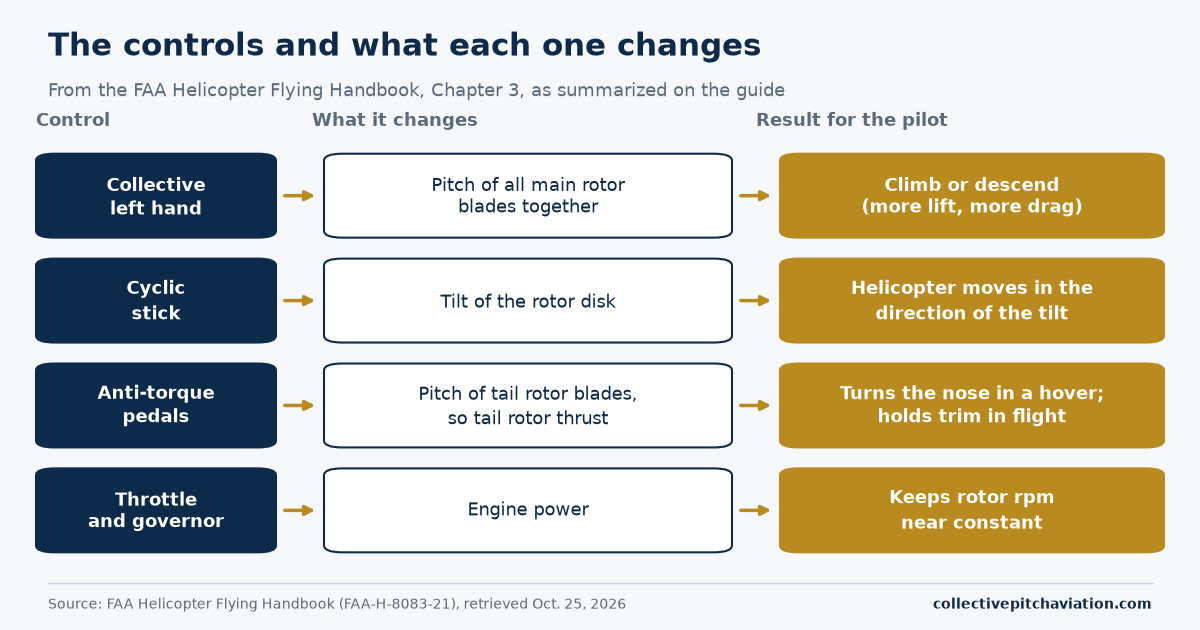
Chapter 3 of the handbook describes three major controls plus the throttle.
Collective pitch: why the name
The collective sits beside the pilot's seat and is worked with the left hand. Raising it increases the pitch angle of all main rotor blades by the same amount at the same moment. Lowering it decreases them. The handbook says it changes pitch "collectively," which is the origin of the name collective pitch (Chapter 3). More pitch means more lift, so raising it makes a hovering helicopter climb. It also adds drag, so engine power must rise to keep rotor speed steady.
Cyclic: tilting the rotor disk
The cyclic is a stick that comes up from the floor, between the pilot's legs or between the two seats in some models. It tilts the rotor disk, and the helicopter moves in the direction of the tilt: forward, back, left or right (Chapter 3).
Anti-torque pedals: holding the nose
When the engine turns the main rotor one way, the fuselage tends to turn the other way. This is Newton's third law at work (Chapter 3). Most single-rotor helicopters answer this with a tail rotor. The pedals on the cabin floor change the pitch of the tail rotor blades, and so the tail rotor's thrust. In a hover, the pedals turn the helicopter left or right. At higher speeds, they keep the aircraft in trim (Chapter 3).
Throttle and governor: keeping rotor speed steady
Rotor rpm must stay near constant. The throttle, usually a twist grip on the collective, sets engine power by hand. A governor senses engine and rotor rpm and adjusts power automatically. Governors are common on turbine helicopters and used on some piston ones (Chapter 3).
Hovering: three controls working at once
The handbook calls hovering the most challenging part of flying a helicopter. The aircraft makes its own gusty air in a hover, which pushes on the fuselage and control surfaces, so the pilot must keep making corrections (Chapters 1 and 2). The roles are simple. The cyclic stops drift. The collective holds height. The pedals hold heading. The difficulty is that changing one control calls for changes to the other two, so the corrections never stop (Chapter 1).
Translational lift: the boost when moving forward
When a helicopter moves forward, or meets wind, the rotor becomes more efficient. The handbook calls this improved efficiency translational lift (Chapter 2). Between about 16 and 24 knots, the rotor outruns its own disturbed air and works in smoother air. This point is called effective translational lift. As it is reached, the nose tends to rise and the helicopter tends to roll right, so the pilot applies forward and left cyclic to hold the attitude (Chapter 2).
Autorotation: landing without engine power
Autorotation is a state of flight in which air moving up through the rotor, not the engine, keeps the main rotor turning (Chapter 2). A freewheeling unit, a special clutch, disconnects the engine from the rotor if the engine fails or slows below rotor speed. The rotor then keeps turning freely (Chapter 11). Every helicopter must demonstrate this ability to be certified (Chapter 2).
In an engine failure, the handbook says the collective must be lowered immediately. That reduces lift and drag and starts a descent, and air flowing up through the disk keeps the rotor turning. The tail rotor is driven from the main rotor's transmission during autorotation, so the pedals still control heading (Chapter 11). Near the ground the pilot flares to slow down, then uses the collective to cushion the touchdown (Chapter 11).
Why helicopters are harder to learn than airplanes
The handbook says a helicopter pilot works in three dimensions and uses both arms and both legs constantly, with coordination, timing and control touch all at once (Chapter 1). It also notes that helicopters are not very stable but are very controllable. If a gust drops the nose, the nose tends to keep dropping rather than return to level, as it would on a fixed-wing aircraft, so the pilot must fly it at all times (Chapter 9).
An AOPA Flight Training writer who took up helicopters described the work as like juggling or playing drums, and said some airplane habits get in the way. The writer's example was reading a fast loss of airspeed on a steep approach as a stall (AOPA, 2014). The article adds that radio, navigation and other basics come easier in an airplane and carry over to a helicopter. This is one person's account, not FAA guidance.
What this means for training
- The hover is a core skill. The handbook calls it the most challenging part of flying a helicopter. See helicopter pilot training for how programs are structured.
- Fundamentals come first. The handbook says most student difficulties come from a lack of training, practice or understanding of the basic maneuvers (Chapter 9).
- Emergency practice is standard. Autorotations are part of training, as described above.
- Robinson R22 and R44 have extra rules. Federal Special Federal Aviation Regulation No. 73 requires added ground training on topics such as energy management, mast bumping, low rotor rpm and low-G conditions. See R22 vs R44.
- Airplane pilots should expect new skills. The AOPA writer said adding helicopters felt like starting over. See airplane to helicopter.
- A discovery flight shows the controls first-hand. See helicopter discovery flight.
Frequently asked questions
Why is it called collective pitch?
The control changes the pitch angle of all the main rotor blades at once, or collectively. Raising it adds pitch to every blade by the same amount. Lowering it takes pitch off every blade (Chapter 3).
What does the tail rotor do?
It counters the torque of the main rotor, which would otherwise turn the fuselage the opposite way. The pedals change tail rotor thrust, which turns the nose at a hover and keeps the aircraft in trim in flight (Chapter 3).
Can a helicopter land if the engine fails?
Yes, by autorotation. Air flowing up through the rotor keeps it turning, and the pilot uses it to glide and land. All helicopters must show this ability to be certified (Chapter 2).
Is a helicopter harder to fly than an airplane?
The handbook calls hovering the most challenging part of flying a helicopter, and the pilot uses both hands and both feet constantly (Chapters 1 and 2). Difficulty differs by person, so a discovery flight is a practical way to find out.
Sources
- FAA, Helicopter Flying Handbook (FAA-H-8083-21), landing page. https://www.faa.gov/regulations_policies/handbooks_manuals/aviation/helicopter_flying_handbook. Retrieved October 25, 2026
- FAA Helicopter Flying Handbook, Chapter 1, Introduction to the Helicopter. https://www.faa.gov/sites/faa.gov/files/regulations_policies/handbooks_manuals/aviation/helicopter_flying_handbook/hfh_ch01.pdf. Retrieved October 25, 2026
- FAA Helicopter Flying Handbook, Chapter 2, Aerodynamics of Flight. https://www.faa.gov/sites/faa.gov/files/regulations_policies/handbooks_manuals/aviation/helicopter_flying_handbook/hfh_ch02.pdf. Retrieved October 25, 2026
- FAA Helicopter Flying Handbook, Chapter 3, Helicopter Flight Controls. https://www.faa.gov/sites/faa.gov/files/regulations_policies/handbooks_manuals/aviation/helicopter_flying_handbook/hfh_ch03.pdf. Retrieved October 25, 2026
- FAA Helicopter Flying Handbook, Chapter 4, Helicopter Components, Sections, and Systems. https://www.faa.gov/sites/faa.gov/files/regulations_policies/handbooks_manuals/aviation/helicopter_flying_handbook/hfh_ch04.pdf. Retrieved October 25, 2026
- FAA Helicopter Flying Handbook, Chapter 9, Basic Flight Maneuvers. https://www.faa.gov/sites/faa.gov/files/regulations_policies/handbooks_manuals/aviation/helicopter_flying_handbook/hfh_ch09.pdf. Retrieved October 25, 2026
- FAA Helicopter Flying Handbook, Chapter 11, Helicopter Emergencies and Hazards. https://www.faa.gov/sites/faa.gov/files/regulations_policies/handbooks_manuals/aviation/helicopter_flying_handbook/hfh_ch11.pdf. Retrieved October 25, 2026
- AOPA Flight Training, "Rotorcraft Rookie: 10 lessons from learning to fly helicopters" (June 5, 2014). https://www.aopa.org/news-and-media/all-news/2014/june/05/rotorcraft-rookie-things-i-learned. Retrieved October 25, 2026
- 14 CFR Part 61, Special Federal Aviation Regulation No. 73, eCFR. https://www.ecfr.gov/current/title-14/part-61/appendix-Special%20Federal%20Aviation%20Regulation%20No.%2073. Retrieved October 25, 2026
Disclosure: this page may contain ads and links. Sponsored items are always labeled. See our disclosure(/advertising-and-affiliate-disclosure/). This is general information, not career, legal or financial advice.