Last reviewed: October 25, 2026. Facts on this page come from the eCFR text of 14 CFR (current as of October 22, 2026), VA.gov, employer career pages and a federal job announcement, each retrieved on the date shown. This site is not affiliated with the FAA, the VA or any military branch. Rules and programs change, so confirm each item with the FAA, the VA or the employer before relying on it.
Military helicopter pilots leave service with real flying experience, but a civilian employer cannot hire on that experience alone. The pilot needs FAA certificates, a logbook that employers can read, and hours in the categories employers count. This guide covers the FAA conversion rule, how GI Bill money can be used, how to present hours, which employers say they recruit veterans, and where to go for the Army, warrant officer, Coast Guard and Navy and Air Force routes.
Quick answerThe FAA rule for military pilots is 14 CFR 61.73. In plain words, a U.S. military pilot or former military pilot who was not removed from flying status for lack of proficiency or for discipline involving aircraft operations may apply for a commercial pilot certificate, an instrument rating or a type rating. The applicant needs official military records, a passed military competency knowledge test, and either a passed military pilot and instrument proficiency check or 10 hours as a military pilot in the kind of aircraft sought (14 CFR 61.73(a) and (b), eCFR current as of Oct. 22, 2026). The rule does not issue an airline transport pilot certificate on its own, and employers still set their own hour minimums. For GI Bill flight training outside a degree, the VA caps tuition and fees at $17,661.89 for August 1, 2026 to July 31, 2027 (VA.gov).
Converting military ratings to FAA certificates (14 CFR 61.73)
Who qualifies
Section 61.73(a) opens the door to "a U.S. military pilot or former military pilot." It excludes anyone removed from flying status for lack of proficiency or because of a disciplinary action involving aircraft operations. Paragraph (c) sets a parallel route for a military pilot of a foreign country that is a contracting State to the Convention on International Civil Aviation, if that pilot is assigned to pilot duties in the U.S. Armed Forces for purposes other than receiving flight training.
What a qualified pilot can apply for
Paragraph (a) lists three items:
| What the pilot applies for |
Section |
Plain-language point |
| Commercial pilot certificate with the appropriate aircraft category and class rating |
61.73(a)(1) |
The category and class must match the kind of aircraft in the military records |
| Instrument rating with the appropriate aircraft rating |
61.73(a)(2), 61.73(d) |
Needs a passed military instrument proficiency check in that category and a record that the pilot is instrument qualified for federal airways |
| Type rating |
61.73(a)(3), 61.73(e) |
Only for a type that has a comparable civilian type designation set by the FAA |
Two related options sit in other paragraphs. A military instructor pilot or pilot examiner can apply for a flight instructor certificate if the person already holds a commercial or ATP certificate and an instrument rating, passes a flight instructor knowledge test within 24 calendar months before the month of application, and presents specific military records (61.73(g)). A military pilot who already holds an airline transport pilot certificate with the category and class rating can have a type rating placed on it at the ATP level after passing an official military pilot check and instrument proficiency check in that type (61.73(f)).
Paperwork the regulation describes
Paragraph (h) lists the documents. In summary, the applicant presents official U.S. Armed Forces records showing (1) that the person is or was a military pilot, (2) graduation from a military undergraduate pilot training school with a pilot rating qualification, and (3) a passed pilot proficiency check and instrument proficiency check in an aircraft. Paragraph (b)(3) then requires official records showing either a passed military pilot and instrument proficiency check in a military aircraft of the kind of category, class and type sought, or 10 hours of pilot time as a military pilot in that kind of aircraft before the date of application.
The section text read for this page does not mention a board, a panel or a hearing. It also lists no practical test. The knowledge requirement is a passed "military competency" aeronautical knowledge test on the parts of the regulations covering commercial pilot privileges and limitations, air traffic and general operating rules, and accident reporting (61.73(b)(2)). Ask an FAA Flight Standards District Office, a designated examiner or a flight school how that test is given and what records they will accept, because the regulation text does not describe the logistics.
Limits to know
- Category and class follow the records. A pilot whose records show rotorcraft helicopter time converts to that category and class. Airplane privileges are not created by helicopter records. The records must show a check or 10 hours "in the kind of aircraft category, class, and type" sought (61.73(b)(3)). A helicopter pilot who wants an airplane rating uses the add-on rules in helicopter to airplane.
- Type ratings are limited. A type rating can be issued only for a type with a comparable civilian designation (61.73(e)).
- ATP is a separate path. The conversion rule lists a commercial certificate, an instrument rating and a type rating. It does not list an ATP certificate. The ATP aeronautical experience rules are in 14 CFR 61.159 to 61.161, and 61.153(d)(2) lets a rated military pilot meet the commercial-and-instrument prerequisite through the 61.73 military experience requirements. The rotorcraft ATP experience rule (14 CFR 61.161) requires at least 1,200 hours of total time, including 500 cross-country, 100 night and 200 in helicopters (see the table in the training cost guide).
- Medical certificate. The FAA medical rules in 14 CFR 61.23 still apply to exercising commercial privileges: at least a second-class medical certificate (see requirements).
- Employers may not follow the FAA's flexibility. The U.S. Customs and Border Protection pilot announcement reviewed for this page says "No Military Flight Hour Conversion Allowed" for its hour minimums (USAJOBS, announcement AIA 27-01 13051330, open October 1 to 31, 2026), while accepting an equivalent military rating shown by official orders, forms or logbooks. Read each employer's hour wording.
GI Bill rules for flight training
The VA says a person may use benefits for flight training at a pilot school or training center if all of these are true (VA.gov, Flight training, updated July 9, 2025):
- The person qualifies for the Post-9/11 GI Bill, Montgomery GI Bill Active Duty or Montgomery GI Bill Selected Reserve.
- The person holds a private pilot's license.
- On the day of enrollment, the person holds a second-class medical certificate valid for second-class privileges (or first-class if pursuing the ATP certificate).
- The Part 141 pilot school or Part 142 training center is FAA certified and the flight program is approved for VA education benefits.
The VA lists "Rotary wing" among example certifications. Survivors' and Dependents' Educational Assistance cannot be used at a pilot school or training center, but a college-degree program is a separate route (VA.gov).
| Item |
What the VA states |
Source and date |
| Post-9/11 GI Bill, non-degree flight program |
Net tuition and mandatory fees up to $17,661.89 |
VA.gov rates, August 1, 2026 to July 31, 2027 |
| Montgomery GI Bill Active Duty and Selected Reserve |
Payback of 60% of approved fees |
VA.gov, Flight training, updated July 9, 2025 |
| Full benefit tier |
100% for at least 1,095 days (36 months) of active duty, or a Purple Heart on or after September 11, 2001, or at least 30 continuous days with a service-connected disability discharge |
VA.gov rates page |
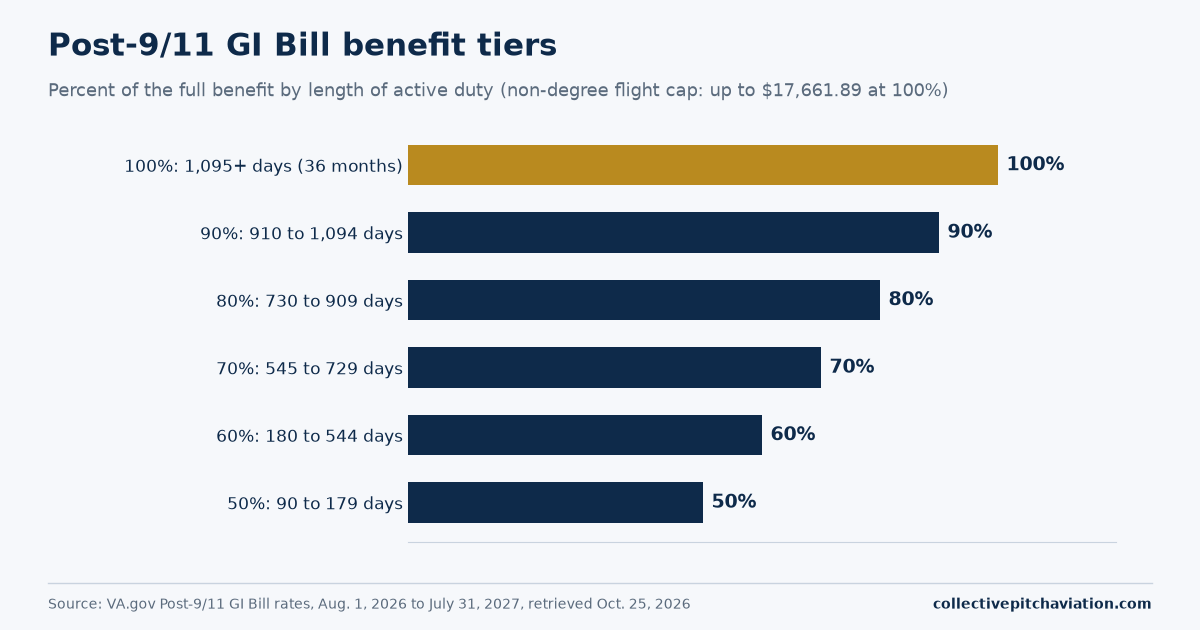
| Partial tiers |
90% (910 to 1,094 days), 80% (730 to 909), 70% (545 to 729), 60% (180 to 544), 50% (90 to 179) |
VA.gov rates page |
The VA says the listed rates are for 100% of the full benefit; anyone at a lower tier multiplies the cap by the percentage. Applying this page's own arithmetic: at the 90% tier, 0.90 x $17,661.89 equals $15,895.70 (rounded to the cent; our arithmetic, not a VA figure).
Because the private pilot certificate is a prerequisite, a military pilot who has converted to a commercial certificate under 61.73 may already hold the prerequisite. Whether a specific program is approved is a question for the school's VA certifying official and the VA's GI Bill Comparison Tool. See financing for loans and scholarships, and training cost for published school prices.
Translating hours and writing a civilian resume
How the FAA treats military flight time
Under 14 CFR 61.51(j), flight time can be logged if it was acquired in an aircraft that is, among other options, "a military aircraft under the direct operational control of the U.S. Armed Forces." Section 61.51(k) defines night vision goggle time that may be logged: time when the pilot uses goggles as the primary visual reference of the surface during a night vision goggle operation. Section 61.51(e) sets the conditions for logging pilot-in-command time, such as being the sole manipulator of the controls of an aircraft the pilot is rated for, the sole occupant, or acting as pilot in command when more than one pilot is required.
The 61.73 conversion rule is about certificates, not about rewriting a logbook. It asks for official records, not for a recount of each flight. A pilot should keep a personal logbook or an official flight records printout that totals hours by category, and ask each employer how it counts military time.
What civilian employers publish
Published minimums differ by employer and by program. The table restates what each employer's own page says (see who's hiring for the full data).
| Employer |
Published hour wording |
Source and date |
| Air Methods, rotor-wing VFR program |
2,000 total, with 1,500 in category; 1,000 PIC in category; 500 rotor-wing turbine; 200 cross-country (50 at night); 100 unaided night as PIC; 50 actual or hood instrument in category. Up to 50 of the unaided night hours can be replaced by 100 NVG hours. |
airmethods.com pilot careers, retrieved Oct. 25, 2026 |
| PHI Air Medical |
2,000 total; 1,500 helicopter; 1,000 helicopter PIC; 500 turbine; 100 unaided night, or 50 unaided plus 100 NVG; 100 instrument |
phiairmedical.com pilot careers, retrieved Oct. 25, 2026 |
| Metro Aviation, rotor wing |
2,000 total for PIC positions; 1,000 rotor-wing for PIC; 500 cross-country; 100 night including 50 unaided; 75 instrument (50 in flight) for IFR PIC positions |
choosemetro.metroaviation.com pilots, retrieved Oct. 25, 2026 |
| Air Evac Lifeteam (GMR), one posting |
2,000 total; 1,500 helicopter; 1,000 helicopter PIC; 500 turbine; 100 night unaided, or 50 unaided with 100 aided |
careers.gmr.net posting, retrieved Oct. 25, 2026 |
| U.S. CBP Air and Marine Operations |
1,500 flight hours at entry on duty (up to 500 waivable), 250 PIC, 75 instrument, 75 night; no military flight hour conversion |
usajobs.gov announcement AIA 27-01 13051330, retrieved Oct. 25, 2026 |
Two points stand out. First, the air medical employers read hours by category (helicopter, PIC, turbine, night, instrument, cross-country). A raw military total does not answer those questions. Second, Air Methods and PHI both treat NVG time as a possible substitute for part of the unaided night requirement, which is useful to a pilot with goggle hours. Check the exact substitution wording on the employer page.
What to put on the resume
- Certificates and ratings with dates: FAA commercial, instrument, any CFI or type ratings, and the FAA medical class. State whether the certificate was issued under 61.73.
- Hours by category: total, helicopter, PIC, turbine, night, NVG, instrument (actual and simulated), cross-country, and hours in the last 12 months. Use the category names from the postings you are targeting.
- Aircraft flown: type and hours in each, exactly as recorded in official records.
- Role history: instructor pilot, evaluator, aircraft commander and similar roles, stated with the military's own titles and a short plain-language gloss.
- Do not invent or round up. Employers verify logbooks. If a number is unknown, request an official flight record before writing it down. Do not convert military hours into civilian categories by guesswork; ask the employer how it counts them.
Employer programs that recruit veterans
The list below uses only statements on each employer's own pages. It is not a ranking, and it says nothing about pay, hiring odds or fit.
| Employer |
What its page says |
Source |
| Air Methods |
States that almost 30% of its workforce has served or is serving in the military. Its military transition team (veterans and active reservists) says it will target the resume, refer to positions and locations, and coach interview preparation. |
airmethods.com military careers page, retrieved Oct. 25, 2026 |
| PHI Air Medical |
Describes itself as a DoD SkillBridge partner, with structured programs during the final six months of military service. The PHI Group page for its oil and gas business also links a SkillBridge page. |
phiairmedical.com career opportunities and phihelico.com careers, retrieved Oct. 25, 2026 |
| Metro Aviation |
Lists a "Mil to Metro" page, profiles former Army and Air Force pilots, and states it partners with BreakTurn to offer SkillBridge positions during the last 180 days of active duty. |
choosemetro.metroaviation.com/mil-2-civ/, retrieved Oct. 25, 2026 |
| Global Medical Response (parent of Air Evac Lifeteam and other air medical brands) |
Describes itself as veteran, military and reserve-friendly, lists a SkillBridge program for service members in their last 180 days with pilot among the roles, and names a Hiring Our Heroes partnership. |
careers.gmr.net/military, retrieved Oct. 25, 2026 |
| U.S. CBP Air and Marine Operations |
The announcement says veterans' preference does not apply to selections under its Direct Hire Authority, that veterans are considered with all applicants, and that certain veterans may be eligible for a polygraph waiver. It accepts an equivalent military rating shown by official records. |
usajobs.gov/job/886512600, retrieved Oct. 25, 2026 |
| Bristow Group |
The careers page reviewed shows an equal-opportunity statement that includes veteran status. It describes no military program, so none is claimed here. |
bristowgroup.com/careers, retrieved Oct. 25, 2026 |
External resources (not employer statements)
This site did not copy or summarize the text of either resource. Read them directly.
For military pilots who want airline flying instead, see helicopter to airplane.
Guides to each military route
Frequently asked questions
Does the FAA give a civilian helicopter license to military pilots automatically?
No. Section 61.73 lets a qualified military pilot or former military pilot apply for a commercial certificate, instrument rating or type rating, with official records and a passed military competency knowledge test. It does not grant anything without an application.
Is there a practical test or board under 61.73?
The section text lists records and a knowledge test. It does not mention a practical test or a board. Confirm the process with an FAA office or a designated examiner.
Can the GI Bill pay for your first helicopter training?
The VA requires a private pilot's license before flight training benefits apply, so it generally cannot pay for the first private certificate at a pilot school. A military pilot who converts to a commercial certificate may already satisfy that prerequisite. Confirm with the school's VA certifying official.
Do military hours count toward civilian employer minimums?
It depends on the employer. The FAA lets pilots log time in military aircraft under direct U.S. Armed Forces control (61.51(j)), but one federal announcement states that no military flight hour conversion is allowed. Ask each employer how it counts military time.
Which employers say they recruit veterans?
Air Methods, PHI Air Medical, Metro Aviation and Global Medical Response each describe military programs on their own pages, and the CBP announcement addresses veterans directly. See the table above for exact statements.
Sources
- U.S. Code of Federal Regulations, Title 14, sections 61.23, 61.51, 61.73, 61.153, 61.159, 61.160 and 61.161, eCFR text current as of October 22, 2026. https://www.ecfr.gov/current/title-14/chapter-I/subchapter-D/part-61. Retrieved October 25, 2026.
- U.S. Department of Veterans Affairs, Flight training (updated July 9, 2025). https://www.va.gov/education/about-gi-bill-benefits/how-to-use-benefits/flight-training/. Retrieved October 25, 2026.
- U.S. Department of Veterans Affairs, Post-9/11 GI Bill rates, August 1, 2026 to July 31, 2027. https://www.va.gov/education/benefit-rates/post-9-11-gi-bill-rates/. Retrieved October 25, 2026.
- Air Methods, Military Career Opportunities. https://www.airmethods.com/careers/military/. Retrieved October 25, 2026.
- Air Methods, Pilot Careers. https://www.airmethods.com/roles-at-air-methods/pilots/. Retrieved October 25, 2026.
- PHI Air Medical, Career Opportunities (DoD SkillBridge). https://www.phiairmedical.com/career-opportunities/. Retrieved October 25, 2026.
- PHI Air Medical, Pilot Careers. https://www.phiairmedical.com/career-opportunities/pilots/. Retrieved October 25, 2026.
- PHI Group, Careers. https://www.phihelico.com/careers. Retrieved October 25, 2026.
- Metro Aviation, Mil to Metro. https://choosemetro.metroaviation.com/mil-2-civ/. Retrieved October 25, 2026.
- Metro Aviation, Metro Pilots. https://choosemetro.metroaviation.com/pilots/. Retrieved October 25, 2026.
- Global Medical Response, Military careers. https://careers.gmr.net/military. Retrieved October 25, 2026.
- Air Evac Lifeteam, Helicopter Pilot posting (Big Spring, Texas). https://careers.gmr.net/event-37989/jobs/60733?lang=en-us. Retrieved October 25, 2026.
- Bristow Group, Careers. https://www.bristowgroup.com/careers. Retrieved October 25, 2026.
- U.S. Customs and Border Protection, Air Interdiction Agent, USAJOBS announcement AIA 27-01 13051330. https://www.usajobs.gov/job/886512600. Retrieved October 25, 2026.
- Vertical Aviation International, Mil2Civ (external resource). https://verticalavi.org/initiatives/mil-to-civ/. Retrieved October 25, 2026.
- Air Line Pilots Association, Military-to-Airline Transition Guide (external resource). https://www.alpa.org/advancing-aviation/future-of-the-profession/become-a-pilot/getting-started/military-pathway-us/military-transition-guide. Retrieved October 25, 2026 (listing only).
Disclosure: this page may contain ads and links. Sponsored items are always labeled. See our disclosure(/advertising-and-affiliate-disclosure/). This is general information, not career, legal or financial advice.