Last reviewed: October 25, 2026. Rules and rates come from the U.S. Department of Education, the Department of Veterans Affairs (VA), federal regulations and scholarship administrators, each dated. This guide does not recommend any lender and does not give financial advice. Loan terms change, so confirm every figure with the lender before signing.
Flight training is a major expense, and the way it is financed can matter as much as the price. Borrowing against a career whose early years are often modestly paid carries real risk. This guide explains the main funding routes, who qualifies for each, and what to ask before taking on debt.
Quick answerFunding usually comes from some mix of savings, family help, scholarships, veteran education benefits and loans. Federal student aid generally applies only when the flight training is part of a program at an eligible institution, and the federal rules require the flight program to hold current valid FAA certification (34 CFR 668.8(i)). GI Bill benefits for flight training outside a degree require an FAA-certified Part 141 school or Part 142 training center with a VA-approved program (VA.gov, updated July 9, 2025). Private lenders set their own terms, which vary widely, so compare the total repayment, not only the monthly payment.
Start with the total, then the gap
Before comparing funding options, build the number. Get a written, itemized quote to the certificate you want from each school, add the fees and hidden costs, and add a contingency for extra hours. See What It Costs to Become a Helicopter Pilot and Helicopter Lessons Cost. Then subtract what you can cover without borrowing. What remains is the gap financing must fill.
Option 1: Federal student aid
Federal aid, applied for through the FAFSA, supports programs at institutions that participate in the federal programs. Two sourced points matter:
- Program eligibility. For a program of flight training to be an eligible program for federal aid, it must have current valid FAA certification (34 CFR 668.8(i), eCFR text current as of Oct. 22, 2026). That is one condition of several, and the institution must also participate in the federal programs.
- Typical fit. Aviation degree programs at colleges and universities are the most likely fit. Stand-alone flight schools may or may not participate. Ask each school whether it participates, and ask in writing.
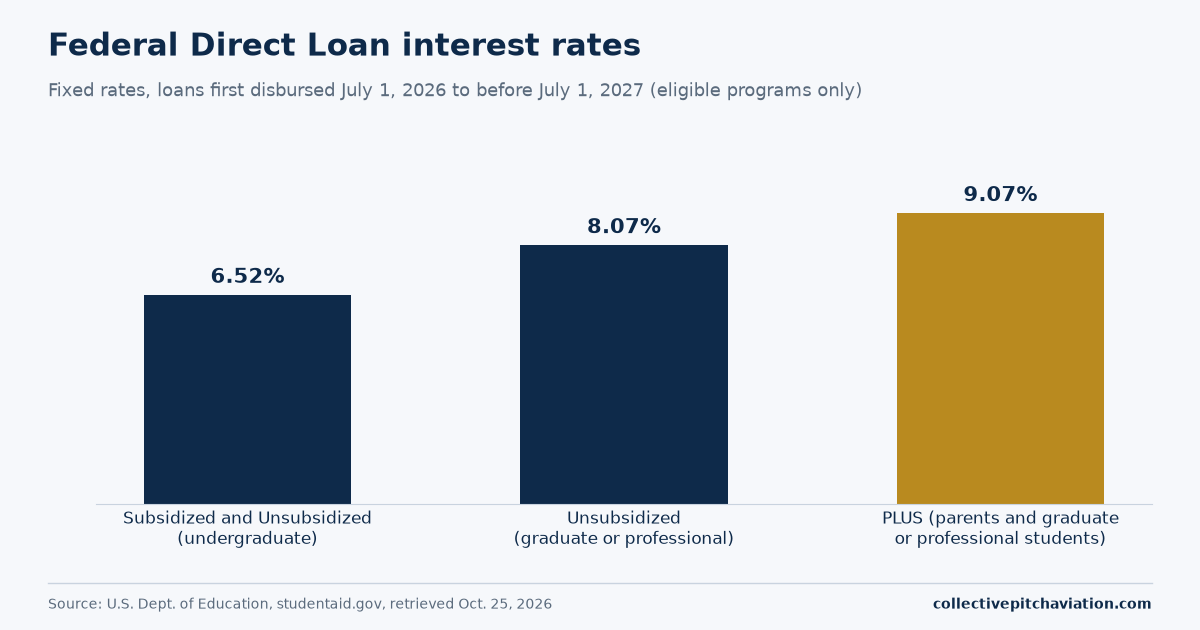
If a program is eligible, the Department of Education lists these fixed rates for Direct Loans first disbursed on or after July 1, 2026 and before July 1, 2027: 6.52 percent for Direct Subsidized and Unsubsidized Loans to undergraduates, 8.07 percent for Direct Unsubsidized Loans to graduate or professional students, and 9.07 percent for Direct PLUS Loans to parents and to graduate or professional students (studentaid.gov, retrieved Oct. 25, 2026). The same page lists loan fees of 1.057 percent for Direct Subsidized and Unsubsidized Loans and 4.228 percent for Direct PLUS Loans first disbursed on or after Oct. 1, 2020 and before Oct. 1, 2027, and says the fee comes out of the amount disbursed, so you receive less than you borrow but repay the full amount. The Department also says interest rates and fees are generally lower for federal student loans than for private student loans.
Annual and aggregate borrowing limits apply and are not covered here. Check them on studentaid.gov and with the school's financial aid office.
Option 2: GI Bill and other VA benefits
For flight training at a pilot school, not inside a college degree, the VA says you must qualify for the Post-9/11 GI Bill or a Montgomery GI Bill program, already hold a private pilot certificate, hold a valid second-class medical certificate on the day you enroll, and train at an FAA-certified Part 141 pilot school or Part 142 training center with a VA-approved program (VA.gov, updated July 9, 2025). Under the Post-9/11 GI Bill, the VA pays approved tuition and fees up to $17,661.89 for a non-degree flight program for August 1, 2026 to July 31, 2027, and Montgomery programs reimburse 60 percent of approved fees (VA.gov rates page). Survivors' and Dependents' benefits cannot be used at a pilot school.
What this means in practice:
- The GI Bill generally cannot fund the first private pilot certificate at a pilot school, because a private certificate is a prerequisite.
- Flight training inside a degree program is treated differently from non-degree training.
- Part 61-only operators generally do not qualify.
Check a school's status in the VA's GI Bill Comparison Tool and confirm with the school's VA certifying official. This site is not affiliated with the VA or any military branch.
Option 3: Scholarships
Scholarships reduce what you must borrow, though awards are competitive and may be small relative to total cost. Sourced examples:
- Vertical Aviation International (VAI). VAI's scholarships page lists awards for the 2027 cycle with a published deadline of December 4, 2026, including the Michelle North Safety, Bell 429 and Bell 505 pilot awards, along with awards aimed at maintenance technicians. The Commercial Helicopter Pilot Rating and WINCO scholarships appear on that page only among 2026 recipients, so they should not be assumed to be open for 2027. Several VAI scholarships list VAI membership among the prerequisites (verticalavi.org, retrieved Oct. 25, 2026). Read the current eligibility, documents and deadline on the page, because they change each cycle. Our scholarships directory lists each program with its deadline and the date we checked.
- Schools and operators. Some schools list their own awards or discounts. Ask the school for the criteria in writing.
- Other aviation associations and foundations. Verify each program on its own site, not on a third-party list, and ignore any scholarship that asks for a fee to apply.
Dollar amounts vary by year and program, so this guide does not quote them. Treat any amount you see on a third-party page as unverified until you read it on the administrator's site.
Option 4: Private and school-affiliated loans
Private lenders and some schools' lending partners offer loans for flight training. Terms vary widely by lender and borrower. Questions that turn a loan offer into something you can compare:
- What is the annual percentage rate (APR), is it fixed or variable, and what does it depend on?
- What fees apply, such as origination or late fees?
- Is a co-signer required?
- Does repayment start while you are training, or after? Does interest accrue in the meantime?
- What is the total amount repaid over the full term?
- Can you prepay without a penalty?
- What happens if you cannot finish, for example because of a medical issue, a school closure or a job-market change?
- Does the loan pay the school directly, and in what increments?
- Is the lender chosen by you, or does the school steer you to one? Get at least one other offer to compare.
Option 5: Pay-as-you-go and savings
Paying per lesson avoids interest and limits risk, but stretches the timeline. Large prepayments carry their own risk if a school closes. Ask for refund terms in writing and avoid paying far ahead of the flying you will do. See our school criteria.
Option 6: Military routes
Military training carries no tuition, in exchange for a service commitment, according to official Army and Air Force pages (goarmy.com and airforce.com, retrieved Oct. 25, 2026). See the cost guide and the Army guide.
Stress-test any loan
Before borrowing, compare the monthly payment with realistic early-career pay, using the sources in our salary guide. BLS reports that the lowest 10 percent of commercial pilots earned less than $58,850 in May 2025, against a $123,220 median, and that some pilots work as instructors or charter pilots while building hours (Occupational Outlook Handbook, retrieved Oct. 25, 2026). BLS does not report first-year helicopter pay, so ask schools and employers what new pilots in your region typically earn. Also consider:
- How long the hour-building stage lasts. See the timeline guide.
- What happens to repayment if your medical status changes.
- Whether you could repay if the first job pays less than planned.
Frequently asked questions
Can you get a student loan for helicopter flight school?
Possibly. Federal loans require an eligible program at a participating institution, with current valid FAA certification for flight programs (34 CFR 668.8(i)). Private loans have their own criteria. Ask each school which lenders it works with.
Can you use the GI Bill for helicopter training?
Sometimes. For non-degree flight training you need a private pilot certificate, a second-class medical and an approved Part 141 school or Part 142 center. See Option 2.
Are there scholarships for helicopter pilots?
Yes. VAI lists pilot awards for its 2027 cycle with a December 4, 2026 deadline, and other organizations publish helicopter-relevant awards (retrieved Oct. 25, 2026). Awards are competitive; see the scholarships directory and check each program's current criteria.
Is a private loan or a federal loan better?
It depends on eligibility and terms. The Department of Education says federal rates and fees are generally lower than private ones (studentaid.gov), but many flight programs do not qualify for federal aid. Compare total repayment.
What credit score do you need?
Lenders set their own criteria and this site found no primary source that states one. Ask each lender directly.
Sources
- U.S. Code of Federal Regulations, Title 34, section 668.8(i) (eligible program, flight training), eCFR text current as of October 22, 2026. https://www.ecfr.gov/current/title-34/subtitle-B/chapter-VI/part-668. Retrieved October 25, 2026.
- U.S. Department of Education, Federal Student Aid, Interest Rates and Fees for Federal Student Loans. https://studentaid.gov/understand-aid/types/loans/interest-rates. Retrieved October 25, 2026.
- U.S. Department of Veterans Affairs, Flight training (updated July 9, 2025). https://www.va.gov/education/about-gi-bill-benefits/how-to-use-benefits/flight-training/. Retrieved October 25, 2026.
- U.S. Department of Veterans Affairs, Post-9/11 GI Bill rates, August 1, 2026 to July 31, 2027. https://www.va.gov/education/benefit-rates/post-9-11-gi-bill-rates/. Retrieved October 25, 2026.
- U.S. Department of Veterans Affairs, GI Bill Comparison Tool. https://www.va.gov/education/gi-bill-comparison-tool. Linked from VA.gov; not queried for individual schools.
- Vertical Aviation International, VAI Scholarships. https://verticalavi.org/vertical-aviation-career-pathways/vai-scholarships/. Retrieved October 25, 2026.
- U.S. Bureau of Labor Statistics, Occupational Outlook Handbook, "Airline and Commercial Pilots" (May 2025 wage data). https://www.bls.gov/ooh/transportation-and-material-moving/airline-and-commercial-pilots.htm. Retrieved October 25, 2026.
- U.S. Army, Army Aviation careers. https://www.goarmy.com/careers-and-jobs/specialty-careers/aviation. Retrieved October 25, 2026.
- U.S. Air Force, Pilot. https://www.airforce.com/careers/aviation-and-flight/pilot/pilot. Retrieved October 25, 2026.
Disclosure: this page may contain ads and, in future, affiliate or referral links to lenders. If a lender pays us when you click or apply, the link will be labeled, and payment will not change what this guide says or which options it lists. See our disclosure(/advertising-and-affiliate-disclosure/). This is general information, not financial, legal or tax advice. Borrowing carries risk; read all terms and talk to a qualified professional.