Last reviewed: October 25, 2026. Figures come from the Bureau of Labor Statistics (BLS) and from the pilot careers pages of two air-medical employers. Where no primary source publishes a dollar figure, this guide says so and does not fill the gap with an estimate.
Search results for air ambulance pilot pay often show a single confident number. The primary sources do not. Federal data does not separate helicopter air ambulance pilots from other commercial pilots, and the employers we reviewed do not publish a dollar range on their pilot pages. This guide shows what can be sourced, what cannot, and how to get a real answer for the job you are considering.
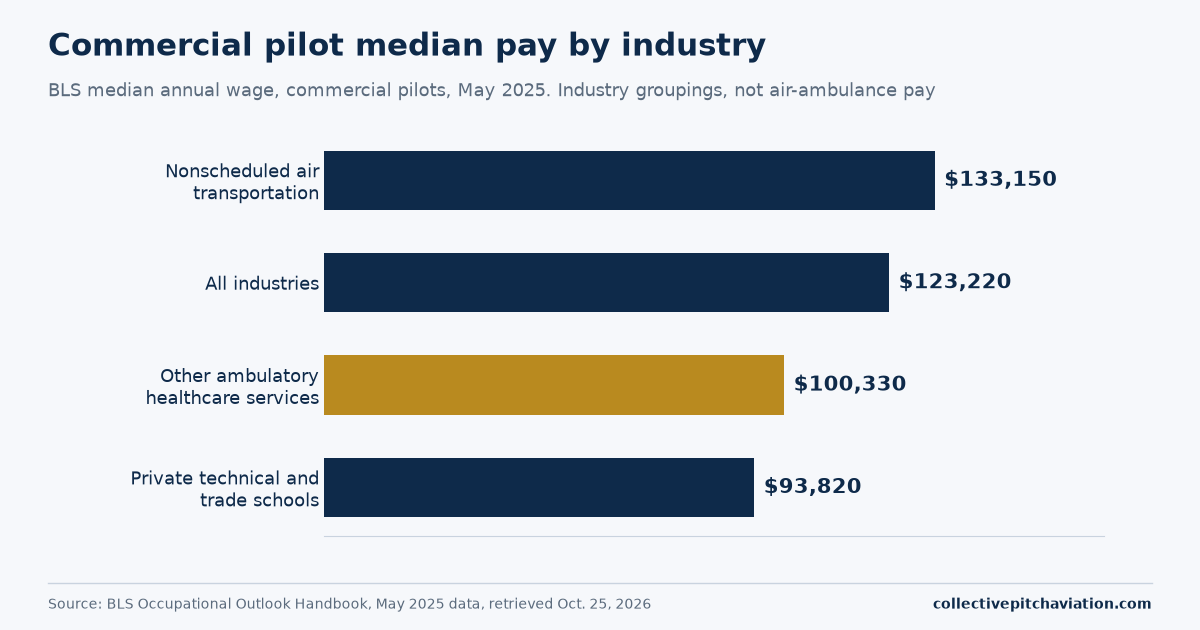
Quick answerThere is no sourced national salary figure for helicopter EMS pilots. BLS reports a May 2025 median of $123,220 for commercial pilots overall, and $100,330 for commercial pilots in the "other ambulatory healthcare services" industry group, which is an industry grouping and not an air-ambulance figure. PHI Air Medical says its pilot salary range is "based on region, flight time, years of EMS experience, and hours with equipment and aircraft specific to the bases" (2026). For the real number, ask the employer for the pay scale for the specific base.
What the data can and cannot tell you
BLS has no helicopter-only line. Commercial pilots are occupation code 53-2012 in the BLS system, and the group covers pilots doing unscheduled work such as aerial application, charter and tours. About 50,400 people held those jobs in 2025. The share of commercial pilot jobs in "other ambulatory healthcare services" was 10 percent (Occupational Outlook Handbook, Airline and Commercial Pilots, retrieved Oct. 25, 2026). BLS does not state how many of those are helicopter air ambulance positions.
An industry median is not a job median. The $100,330 industry figure blends all commercial pilots employed in that industry group, with any aircraft and any experience level. It can be a useful point of reference, but it should not be quoted as "EMS pilot pay."
Job postings differ from realized income. Advertised ranges, where they exist, do not include overtime, bonuses or what is actually earned after a year.
The sourced numbers, side by side
| Measure |
Figure |
Source and date |
| Median annual wage, commercial pilots, all industries |
$123,220 |
BLS, May 2025 |
| Lowest 10 percent of commercial pilots earned less than |
$58,850 |
BLS, May 2025 |
| Highest 10 percent earned more than |
$266,620 |
BLS, May 2025 |
| Median, commercial pilots in "other ambulatory healthcare services" |
$100,330 |
BLS, May 2025 |
| Median, commercial pilots in nonscheduled air transportation |
$133,150 |
BLS, May 2025 |
| Median, commercial pilots in private technical and trade schools |
$93,820 |
BLS, May 2025 |
| Air-ambulance pilot pay range |
Not published on employer pages reviewed |
PHI Air Medical and Metro Aviation pilot careers pages, retrieved Oct. 25, 2026 |
The spread between the lowest and highest tenth shows why one number misleads. Pay at the bottom of the range is often associated with early-career roles, and BLS says some pilots work as instructors or charter pilots to build hours (Occupational Outlook Handbook, retrieved Oct. 25, 2026).
How EMS pilot pay is structured
Structure matters as much as the headline figure. From the employer pages we reviewed:
- Pay factors. PHI Air Medical says its range depends on region, flight time, years of EMS experience, and hours with the aircraft and equipment at each base (2026).
- Bonuses. PHI Air Medical lists shift bonuses, shift incentives and an annual safety bonus (2026).
- Screening and onboarding. PHI Air Medical lists a pre-placement physical with a functional capacity assessment, drug screening and a background screen (2026). Those steps affect hiring timelines, not pay, but they come before the first paycheck.
Metro Aviation's pilot page does not list a pay range or bonus structure in the version we reviewed (2026).
Questions that turn a vague number into a real one
Ask the employer or recruiter, in writing:
- Is pay a salary, an hourly rate, a flight-hour rate or a mix?
- Is there a guaranteed minimum, and does it apply when a base is quiet?
- How are overtime, standby time and holiday work paid?
- Which bonuses exist, and are they in the base pay or paid separately?
- How does pay rise with seniority, and is there a published scale?
- What benefits apply, and when do they start?
- What is the process if a base closes or the contract changes?
Schedules and what they mean for income
EMS programs commonly use extended shifts with days off in between, with time at the base on standby (see our EMS pilot guide). Schedule details vary by employer and base, so treat any description as a starting point. Two sets of questions matter when comparing offers:
- Time at work versus time flying. A pilot may spend most of a shift on standby, so a rate per hour of flight time and a rate per shift can produce very different totals. Ask how both are used.
- Time off versus income. A job with a predictable block of days off can be worth more than a higher rate with unpredictable work. Pay is one part of the comparison.
BLS notes that helicopter pilots in rescue operations may fly at low levels in bad weather or at night and land in areas surrounded by power lines, highways and other obstacles, and that fatalities are uncommon, but airline and commercial pilots experience one of the highest occupational fatality rates (Occupational Outlook Handbook, retrieved Oct. 25, 2026). Weigh that against pay, and see the later accident statistics guide for official data.
What moves EMS pilot pay
- Experience. Employer minimums are well above the legal floor. PHI Air Medical and Metro Aviation each list 2,000 total hours, and PHI lists 1,000 hours of helicopter pilot-in-command time and 500 turbine hours (2026). The FAA floor for a Part 135 VFR pilot in command is 500 hours (14 CFR 135.243(b)). Pay structure often rewards experience, but a pay scale is the only reliable proof.
- Qualifications. An instrument rating or ATP is required for the pilot in command of a helicopter air ambulance (14 CFR 135.603). PHI Air Medical requires an ATP within 12 months of starting (2026). Night vision goggle experience is accepted at some employers as part of the night-hour requirement (see our EMS guide).
- Employer type. Hospital-based programs and contractors differ in benefits, structure and stability.
- Region and cost of living. BLS publishes state and area data on its pilots page, which can be used for geographic context.
- Base stability. Bases can open and close, which affects income continuity.
Is EMS pay worth the cost of getting there?
The path to an EMS job usually includes a full private-to-commercial program plus a period of hour building, often as an instructor. Published full programs from private through flight instructor ran from $90,600 to $95,101 in the two price sheets reviewed in our cost guide (2026), and that is before hour-building income or living costs. Compare the total with the realistic pay in your target region, using the pay scale you obtain. The roadmap explains the steps and the salary guide covers other job types.
Frequently asked questions
How much do helicopter EMS pilots make?
There is no sourced national figure. BLS reports a median of $123,220 for commercial pilots (May 2025) and $100,330 for commercial pilots in the "other ambulatory healthcare services" group, which is not a helicopter air ambulance figure. Ask employers for the pay scale for the base you want.
How much do air ambulance pilots make per hour?
No primary source we reviewed publishes an hourly rate. Some employers pay by shift or salary rather than by the hour, so ask how pay is structured before comparing offers.
Do EMS pilots get bonuses?
Some do. PHI Air Medical lists shift bonuses, shift incentives and an annual safety bonus (2026). Ask other employers what applies.
Is EMS the highest-paying helicopter job?
Sources do not allow that comparison. Published figures do not rank helicopter job types on equal terms, so this site does not claim EMS is highest or lowest.
Do EMS pilots need an ATP?
Not always, but the pilot in command must hold a helicopter instrument rating or an ATP not limited to VFR (14 CFR 135.603). Some employers also require an ATP after hire.
What is the schedule like?
Shift-based, often with extended shifts and days off between them, but it varies by employer and base. Ask for the pattern in writing.
Sources
- U.S. Bureau of Labor Statistics, Occupational Outlook Handbook, "Airline and Commercial Pilots" (May 2025 OEWS wage data; 2025 employment). https://www.bls.gov/ooh/transportation-and-material-moving/airline-and-commercial-pilots.htm. Retrieved October 25, 2026.
- PHI Air Medical, Pilot Careers (hour minimums, salary-range factors, bonuses, screening; 2026). https://www.phiairmedical.com/career-opportunities/pilots/. Retrieved October 25, 2026.
- Metro Aviation, Metro Pilots (hour minimums; 2026). https://choosemetro.metroaviation.com/pilots/. Retrieved October 25, 2026.
- U.S. Code of Federal Regulations, Title 14, sections 135.243 and 135.603, eCFR text current as of October 22, 2026. https://www.ecfr.gov/current/title-14. Retrieved October 25, 2026.
- Hillsboro Aero Academy and Pelican Flight Training published program prices (2026), as cited in What It Costs to Become a Helicopter Pilot.
Disclosure: this page may show ads. See our advertising and affiliate disclosure. This is general information, not career or financial advice.