What a warrant officer is
The Army describes warrant officers as the few technical experts in their field, making up less than three percent of the Army. They solve problems within their area of expertise, advise commanders, train soldiers and officers, and help organize missions (goarmy.com, Warrant Officers, retrieved Oct. 25, 2026). Commissioned officers outrank warrant officers, though the Army says commissioned officers rely on warrant officers' technical expertise.
Most warrant officer specialties require prior service, with a rank of at least sergeant. Aviation is one of two exceptions, which is why many first-time applicants look at it. The Army lists more than 40 warrant officer specialties, and helicopter pilot is one of them.
Who can apply
| Requirement |
What the Army lists for aviation warrant officers |
| Age |
18 to 33 |
| Citizenship |
U.S. citizen or permanent resident with a valid Green Card |
| Education |
High school diploma or equivalent |
| Clearance |
Eligible for a Secret security clearance |
| Health and conduct |
Medically and physically fit; in good moral standing |
Source: goarmy.com, Army Aviation, retrieved Oct. 25, 2026. The state National Guard page described below states the age limit as "not more than 33 at the time of the Federal Recognition Board" and requires U.S. citizenship by birth or naturalization, so the exact rules depend on the component you join. Ask which standard applies to you.
The selection steps
A South Carolina Army National Guard page for aviation warrant officers lists the detailed selection standards used for its applicants (retrieved Oct. 25, 2026):
- ASVAB General Technology score. At least 110. The page notes that applicants can retake an in-service test to raise a score.
- SIFT. A qualifying score of 40 on the Selection Instrument for Flight Training, the Army's aptitude test for flight candidates.
- Flight physical. Class 1A flight physical examination standards under Army Regulation 40-501. The results are reviewed by flight surgeons at Fort Rucker, Alabama, before the selection board, and the exam must be less than 18 months old when the board meets.
- Vision. 20/50 distance vision correctable to 20/20, and 20/20 near vision. The page says certain refractive surgery is permitted, and tells applicants to read the aeromedical policy guidance before having any procedure done.
- Physical fitness. Pass all Army fitness test events with no alternates, and meet height and weight standards.
- Character. Outstanding leadership traits and moral character. The page marks some items, including civil convictions, as potentially waivable.
- The board. An interview, called the IERW Board on that page. Packet format and interview rules are set by the state's aviation officer.
The Army's general page says it also has a waiver process for applicants who do not meet an eligibility requirement (goarmy.com, Rotary Wing Aviator Warrant Officer, retrieved Oct. 25, 2026). A waiver is not a guarantee. Ask a recruiter which of your issues are waivable.
Ask this: What is the current SIFT cutoff for my component? How many applicants do you typically send to each board? When is the next board?
Training phases
After selection, the National Guard page lists these phases, all completed at Fort Rucker, Alabama (retrieved Oct. 25, 2026):
| Phase |
Length listed |
| Aviation Warrant Officer Basic Course |
3 weeks |
| Survival, Evasion, Resistance and Escape course |
3 weeks |
| Initial Entry Rotary Wing (IERW) flight training, common core |
22 weeks |
| Advanced airframe training |
16 weeks |
| Aviation leadership exercise |
3 weeks |
The listed phases add up to 47 weeks (our sum). The page says all of this training is rigorous and requires commitment beyond initial qualification. The Army's recruiting page says Warrant Officer Candidate School is held at Fort Rucker and tests technical and physical skills (goarmy.com, Warrant Officers, retrieved Oct. 25, 2026). The sequence and names can differ by year and component, so ask for the current schedule.
The Army also lists the aircraft pilots may fly depending on specialty: the UH-60 Black Hawk, CH-47 Chinook and AH-64 Apache helicopters, among others (goarmy.com, Army Aviation).
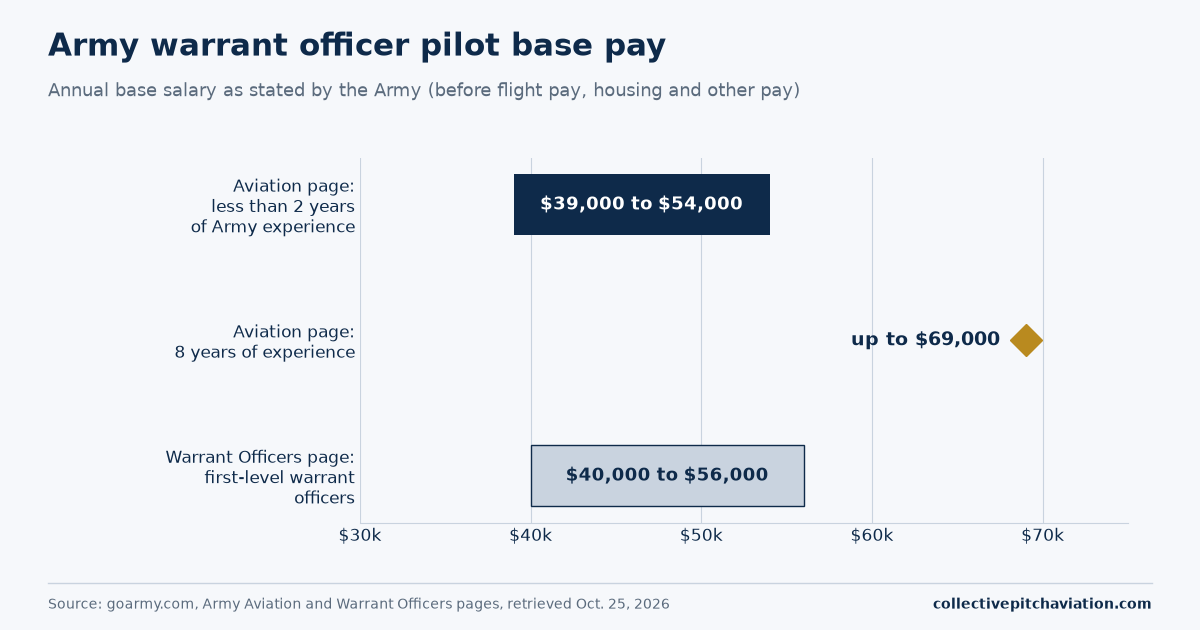
The Army says warrant officer pilots start with a base salary between $39,000 and $54,000 with less than two years of Army experience, and up to $69,000 with eight years, before other pay such as flight pay and housing allowances (goarmy.com, Army Aviation, retrieved Oct. 25, 2026). A separate Army page gives a base range of $40,000 to $56,000 for first-level warrant officers, depending on experience (goarmy.com, Warrant Officers). The pages differ slightly, so check the current pay tables the Army links.
The Army also says warrant officers are promoted after serving two years as a warrant officer (goarmy.com, Warrant Officers, retrieved Oct. 25, 2026).
The commitment
The Army says flight school is paid for by the Army and that aviation warrant officers commit to 10 years of service after they graduate (goarmy.com, Army Aviation). The National Guard page states a 10-year contractual obligation as an active Guard member upon acceptance into, and upon completion of, flight training, beginning October 1, 2020, running concurrently with other obligations.
For a pilot weighing this against self-funded training, the real comparison is years of service versus tuition, income and flexibility. See the cost comparison in our training cost guide.
Warrant officer versus commissioned officer pilots
|
Warrant officer |
Commissioned officer |
| Degree |
Not required; high school diploma or equivalent |
College graduate by commissioning |
| Age (Army aviation page) |
18 to 33 |
At least 17 and under 31 in the year of commissioning |
| Rank relationship (Army statement) |
Outranked by commissioned officers, who rely on warrant officers' technical expertise |
Outranks warrant officers |
Source: goarmy.com, Army Aviation and Warrant Officers, retrieved Oct. 25, 2026. The Army does not say one route is better. The right route depends on your education, age and goals.
How other branches compare
The Navy and the Air Force list a bachelor's degree as a requirement for their pilots (navy.com and airforce.com, retrieved Oct. 25, 2026), so a high school graduate has fewer military options. See the Navy and Air Force comparison. If you are weighing the civilian route, the FAA requirements guide and roadmap show what a civilian pilot needs. After service, see civilian job tracks.
Application checklist
- Confirm age, citizenship and education against the current standard.
- Ask about the SIFT, and plan study time before testing.
- Ask what the flight physical involves, and speak to a recruiter before any vision procedure.
- Gather documents the recruiter lists, including any records tied to conduct or waivers.
- Ask about the commitment in writing.
- Ask what happens if you are not selected or do not complete a phase.
Frequently asked questions
What does WOFT stand for?
It stands for Warrant Officer Flight Training, the Army program that trains aviation warrant officer candidates as pilots.
What score do you need on the SIFT?
A South Carolina Army National Guard page lists a qualifying score of 40 (retrieved Oct. 25, 2026). Cutoffs may differ by component and year, so confirm with a recruiter.
Can you become an Army warrant officer without prior service?
Only for aviation and cyber. The Army says all other warrant officer candidates must be serving on active duty, in the Army Reserve or in the Army National Guard, at a rank of at least sergeant.
How long is Army warrant officer flight training?
The National Guard page lists phases totaling 47 weeks (our sum), not counting application and waiting time.
Do warrant officers get paid during flight school?
The Army says that flight school is paid for and that you receive an Army salary and benefits at the same time (goarmy.com, Army Aviation).
Can you wear glasses?
The National Guard page lists 20/50 distance vision correctable to 20/20 and 20/20 near vision. Medical standards are set by the Army, so confirm with a recruiter or flight surgeon.
Sources
- U.S. Army, Army Aviation careers. https://www.goarmy.com/careers-and-jobs/specialty-careers/aviation. Retrieved October 25, 2026.
- U.S. Army, Warrant Officers. https://www.goarmy.com/careers-and-jobs/find-your-path/warrant-officers. Retrieved October 25, 2026.
- U.S. Army, Rotary Wing Aviator Warrant Officer 153A. https://www.goarmy.com/careers-and-jobs/aviation/managing-piloting-aircraft/153a-rotary-wing-aviator-warrant-officer. Retrieved October 25, 2026.
- U.S. Navy, Helicopter Pilot. https://www.navy.com/careers-benefits/careers/aviation/helicopter-pilot. Retrieved October 25, 2026.
- U.S. Air Force, Pilot. https://www.airforce.com/careers/aviation-and-flight/pilot/pilot. Retrieved October 25, 2026.
- South Carolina Army National Guard, Aviation Warrant Officer. https://nationalguard.com/south-carolina/aviation-warrant-officer. Retrieved October 25, 2026.
Disclosure: this page may show ads and may offer a free application checklist in exchange for an email address. See our advertising and affiliate disclosure. This site is not affiliated with the U.S. Army or any military branch. This is general information, not career or enlistment advice; speak with an official recruiter.