Side-by-side comparison
|
Navy (helicopter pilot page) |
Air Force (pilot page) |
| Education |
Four-year degree required; regionally accredited bachelor's degree, preferably in a technical field |
Bachelor's degree |
| Citizenship |
U.S. citizen |
Not stated on the page reviewed |
| Age |
Not stated on the page reviewed |
Begin pilot training from age 18 until your 33rd birthday |
| Commissioning |
Officer Candidate School, Newport, Rhode Island |
Officer Training School (8.5 weeks, Maxwell AFB, Alabama), Air Force Academy or AFROTC |
| Flight training |
Six-week air indoctrination, then primary, intermediate and advanced phases |
Undergraduate Pilot Training (about 1 year), then aircraft-specific training (6 months to 1 year) |
| Commitment |
Not stated on the page reviewed |
10 years of active duty after pilot training |
| Named helicopters |
MH-60 Romeo and MH-60 Sierra |
Not named on the pilot page reviewed |
Sources: navy.com, Helicopter Pilot, and airforce.com, Pilot, retrieved Oct. 25, 2026.
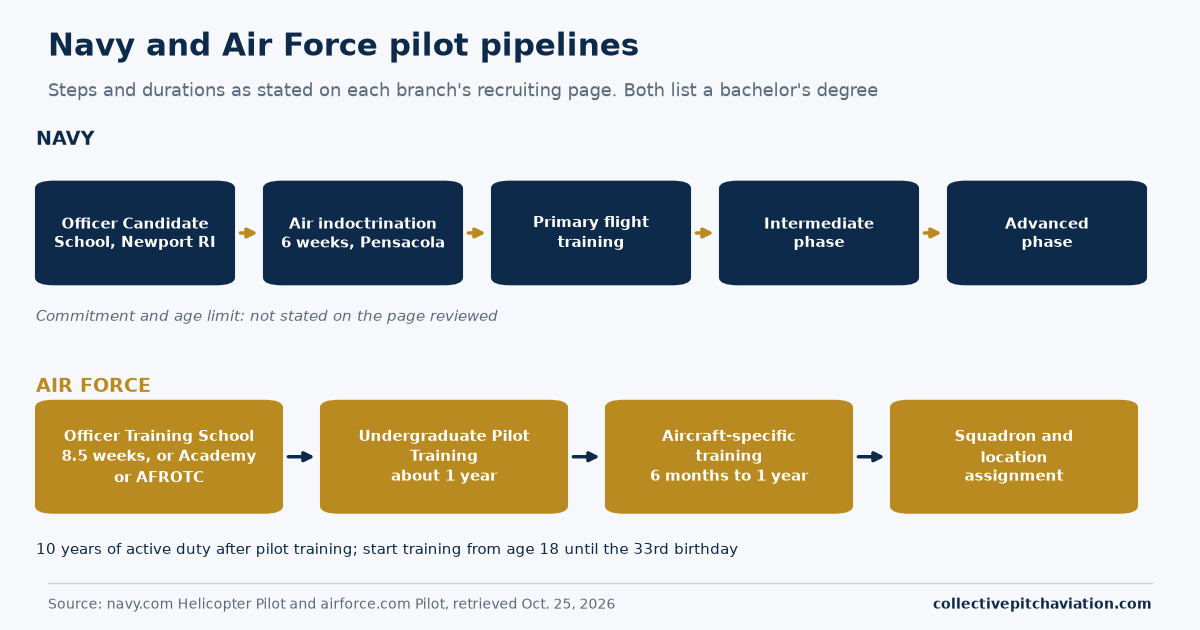
The Navy pipeline
The Navy says those entering aviation programs must first attend Officer Candidate School in Newport, Rhode Island, and then complete a six-week air indoctrination course at Naval Aviation Schools Command in Pensacola, Florida. Prospective helicopter pilots then attend primary flight training. Candidates request an aircraft pipeline and enter the intermediate phase, which builds on basic flight and navigation training. The final phase is advanced naval flight training, which focuses on mission specifics. After completion, pilots receive their wings and report to a Fleet Replacement Squadron for training specific to their aircraft (navy.com, Helicopter Pilot, retrieved Oct. 25, 2026).
On work, the Navy says helicopter pilots may do search and rescue (including hovering 10 feet over water to drop off rescue swimmers), antisubmarine warfare, mine countermeasures, vertical replenishment and fleet logistics support, and may launch from aircraft carriers or surface combatants. The page also says assignments can be anywhere around the globe, including carrier groups, other sea-based platforms and naval air stations.
The page states the Navy's qualification rules: a four-year degree, U.S. citizenship, willingness to serve worldwide and qualification for sea duty. It tells readers to ask a recruiter for specifics. It does not state an age limit or a service commitment, so ask for both in writing.
After the first flying tour, the Navy says pilots can attend the Naval Postgraduate School in Monterey, California, where they may earn a master's or doctoral degree while being paid full-time. Reserve helicopter pilot positions are open only to prior or current military aviators, the page says.
The Air Force pipeline
The Air Force lists a bachelor's degree as the minimum education for pilots, and completion of Officer Training School, the Air Force Academy or AFROTC. Officer Training School is listed as 8.5 weeks at Maxwell Air Force Base, Alabama. The page lists these steps after commissioning (airforce.com, Pilot, retrieved Oct. 25, 2026):
- Enter Undergraduate Pilot Training and begin flight training (about one year).
- Near the end of that training, receive an aircraft assignment, called a seat assignment. The Air Force says it is determined by class ranking, training performance reports, instructor recommendations, your preferences and the service's needs.
- Continue flight training for the assigned aircraft (six months to one year).
- Receive a squadron and location assignment, with location preferences considered.
The page states the commitment: 10 years of active duty after completion of pilot training. It also says applicants must achieve qualifying scores on the AFOQT exam, meet strict physical, medical, vision and academic requirements, and pass a selection board before age 33.
What the Air Force page does not say: The pilot page does not list helicopters or say how many helicopter seats exist. Because seat assignment depends on ranking and need, a person who wants a helicopter cannot assume a helicopter seat. The Air Force also publishes a separate rescue pilot page that describes leading aircrews to rescue personnel in hostile territory or natural disasters, but it, too, lists the same education, training and age requirements and does not name aircraft (airforce.com, Rescue Pilot, retrieved Oct. 25, 2026).
Ask this: How many Undergraduate Pilot Training graduates in recent classes received helicopter seats? Can I list a helicopter as a preference, and how often is it honored?
Which is easier to understand and plan around?
Neither page gives selection odds or acceptance rates. The Navy page describes promotion as "regularly available but competitive and based on performance." The Air Force page requires a selection board. Planning questions that apply to both:
- Degree timeline. Both need a bachelor's degree before commissioning, so someone without a degree would add years to the plan.
- Age. The Air Force states a hard stop at the 33rd birthday for starting training. Ask the Navy for its limit.
- Helicopter certainty. The Navy states helicopter pilot as a distinct job with named aircraft. The Air Force assigns aircraft by class ranking and need, so the helicopter path is less certain.
- Commitment. The Air Force states 10 years of active duty after pilot training. The Navy page reviewed does not state one.
How they compare with the Army and Coast Guard
The Army has a warrant officer route that accepts a high school diploma, which the Navy and Air Force pages do not; see warrant officer flight training and the Army guide. The Coast Guard describes a route through Officer Candidate School and Naval Flight School in Pensacola with roughly two years to wings; see the Coast Guard guide.
Military versus civilian training cost
Military flight training does not charge tuition, but it carries a service obligation, as the Air Force's 10-year statement shows. Civilian training costs vary widely by school; see our cost guide for published prices with dates. For the civilian FAA steps, see requirements and the roadmap.
Questions to ask a recruiter
- What is the current age limit, and does it apply when I apply or when I start training?
- Which degrees are preferred or required?
- What is the service obligation, and when does it begin?
- Can I choose helicopters, and how are assignments decided?
- What happens if I am medically disqualified or do not complete flight training?
- Which parts of the training convert to FAA certificates?
Frequently asked questions
Do the Navy and Air Force require a college degree for pilots?
Yes. The Navy says a four-year degree is required to work as a pilot, and the Air Force lists a bachelor's degree as the minimum education (navy.com and airforce.com, retrieved Oct. 25, 2026).
Can the Air Force guarantee a helicopter seat?
The Air Force pilot page does not say. It says aircraft assignment is determined by class ranking, training performance, instructor recommendations, preferences and the service's needs.
How long is the Air Force commitment for pilots?
The Air Force says 10 years of active duty after completion of pilot training.
What helicopters does the Navy name for its pilots?
The MH-60 Romeo and the MH-60 Sierra (navy.com, Helicopter Pilot, retrieved Oct. 25, 2026).
Is there an age limit for Navy helicopter pilots?
The Navy page reviewed does not state one. Ask a recruiter.
Which is better for a future civilian helicopter career?
No source we reviewed compares them. Civilian employers set their own hour and certificate requirements; see job tracks.
Sources
- U.S. Navy, Helicopter Pilot. https://www.navy.com/careers-benefits/careers/aviation/helicopter-pilot. Retrieved October 25, 2026.
- U.S. Air Force, Pilot. https://www.airforce.com/careers/aviation-and-flight/pilot/pilot. Retrieved October 25, 2026.
- U.S. Air Force, Rescue Pilot. https://www.airforce.com/careers/aviation-and-flight/pilot/rescue-pilot. Retrieved October 25, 2026.
- U.S. Coast Guard, Aviation (officer careers). https://www.gocoastguard.com/careers/officer/aviation. Retrieved October 25, 2026.
- U.S. Army, Army Aviation careers. https://www.goarmy.com/careers-and-jobs/specialty-careers/aviation. Retrieved October 25, 2026.
Disclosure: this page may show ads. See our advertising and affiliate disclosure. This site is not affiliated with the U.S. Navy, U.S. Air Force or any military branch. This is general information, not career or enlistment advice; speak with an official recruiter.