For a summary of the numbers and what they cannot say about one person's risk, read helicopter crash statistics alongside this page.
Using NTSB CAROL
CAROL stands for Case Analysis and Reporting Online. It is the NTSB's query tool for investigations and safety recommendations (NTSB, "CAROL Help"). Its link is carol.ntsb.gov (external). According to NTSB, aviation records go back to 1962, and over 15,000 safety recommendations are searchable.
Search types and rules
NTSB's help page describes four ways to search: basic, custom builder, aviation investigation and published searches. The aviation search returns only records meeting every criterion entered. In the custom builder, each rule has a field, a condition (such as "contains" or "is after") and a value, and a user can require results to match any or all rules, including in groups (NTSB, "CAROL Advanced Search Help").
Fields that matter for helicopter research
The NTSB's CAROL Guide defines the database fields. Several are useful for helicopter questions (descriptions paraphrased from that guide):
| Field |
What it does |
| Event date, state |
Narrow results by when and where. |
| Highest injury level |
The highest injury level among all injuries in the event. |
| Event type |
Accident, incident or occurrence. A regulatory definition of severity, available in advanced search. |
| Aircraft category, make, model |
Filter by the kind of aircraft and manufacturer. Make and model are free text in advanced search. |
| FAR part |
The 14 CFR part or authority the aircraft was operating under. |
| Purpose of flight |
Categories such as personal, business and aerial application. |
| Status |
Completed or in-work. |
| Probable cause, narratives |
Free-text searches of the probable cause and narratives. |
Results can be downloaded as CSV or JSON. Some fields exist only in advanced search, and operator name appears only in the JSON download.
Accident, incident, preliminary and final
Accident versus incident
The federal rule that governs NTSB reporting (49 CFR 830.2) defines an aircraft accident as an occurrence during flight operation in which a person suffers death or serious injury, or the aircraft receives substantial damage. An incident is an occurrence other than an accident that affects or could affect the safety of operations. The rule defines a fatal injury as one that results in death within 30 days of the accident. Substantial damage has its own definition, and some damage types, such as damage limited to one engine, are excluded from it (eCFR, 49 CFR 830.2).
Investigation classes
The NTSB investigates all civil aviation accidents and selected incidents. It assigns each investigation a class from 1 to 4 that reflects depth. Class 1 is reserved for very significant accidents, generally with transport category aircraft. Class 4 investigations are limited in scope, are generally done remotely, and per NTSB produce a final report within 6 months. The initial class can change as the investigation proceeds (NTSB, "Aviation Investigation Classification," updated October 30, 2024).
Preliminary and final reports
For general aviation accidents, the NTSB describes the preliminary report as a synopsis of facts gathered on scene, typically available within about two weeks. The final report adds analysis, findings and the probable cause, replaces the preliminary report, and comes about 18 to 24 months after the accident (NTSB, "Aviation Accident"). NTSB generally aims to finish investigations in 12 to 24 months (NTSB, "The Investigative Process").
A record without a probable cause is not finished, so check the report status.
FAA data sources
- Accident and incident data page. The FAA publishes a hub for accident and incident data. It links to preliminary notices, which cover events reported in roughly the past 10 business days and are marked as preliminary and subject to change. For details on a specific event, the FAA directs readers to the NTSB (FAA, "Preliminary Accident and Incident Notices").
- Aviation Safety Information Analysis and Sharing (ASIAS). The FAA's data-sharing system. Its catalog includes the Accident/Incident Data System (AIDS), which holds incident records for general aviation and commercial air carriers since 1978. ASIAS says its AIDS database contains incidents only, because ASIAS uses the NTSB database as its primary source for accidents (FAA ASIAS).
- FAA Rotorcraft Accident Dashboard. A monthly dashboard of U.S.-registered rotorcraft events, hosted by the USHST and described below.
What "per 100,000 flight hours" means
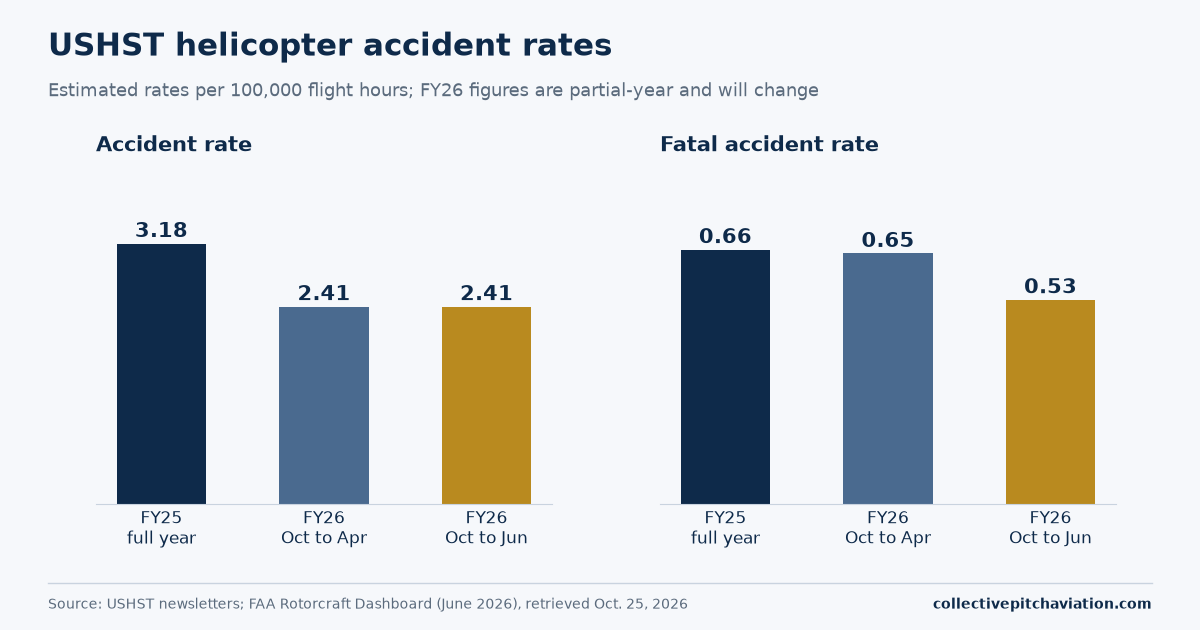
A rate divides the number of events by the amount of flying and scales the result. A rate of 0.53 per 100,000 flight hours means 0.53 fatal accidents for every 100,000 hours flown by the group measured. It describes a group, not any one pilot.
Counts alone mislead for three reasons:
- Flying volume changes. More hours flown usually means more events, even if risk per hour is unchanged. A rate adjusts for that.
- Groups differ in size. A sector with few hours can show few accidents and still have a high rate. A large sector can show many and a low rate.
- Small numbers swing. One or two events can move a percentage sharply.
Why flight-hour data are imperfect
The FAA dashboard states how it gets hours. For fiscal year 2025-26 its rates rest on the FAA's FY2025-2045 forecast, while historic hours come from the General Aviation and Part 135 Activity Survey, which categorize hours by calendar year (FAA Rotorcraft Accident Dashboard, June 2026). So current-year hours are forecasts, not counts. The same dashboard says accident numbers can change after FAA and NTSB data are compared, and that its data are subject to change.
One visible effect: the spring newsletter reported 41 accidents for October through April, while the June dashboard's monthly row for those months adds to 42, with the same 11 fatal accidents. Always check the date.
The USHST is a volunteer group of manufacturers, flight schools, the FAA, the NTSB and industry groups (USHST spring 2026 newsletter). Its fiscal year runs October to September.
| Period |
Accidents |
Fatal accidents |
Fatalities |
Accident rate |
Fatal accident rate |
Source and date |
| FY26 Oct-Jun (latest found) |
54 |
12 |
23 |
2.41 |
0.53 |
FAA Rotorcraft Accident Dashboard, report month June 2026 |
| FY26 Oct-Apr |
41 |
11 |
21 |
2.41 |
0.65 |
USHST Spring 2026 newsletter |
| FY25 full year |
96 |
20 |
41 |
3.18 |
0.66 |
USHST Fall 2025 newsletter |
The June dashboard is a graphic PDF, and its figures were transcribed from the rendered page, so confirm them on the source before you cite them. Rates are per 100,000 flight hours. The June dashboard also lists a fatality rate of 1.03, and a fatal accident rate of 0.74 for the same period of the prior year (28 percent lower in FY26; 12 fatal accidents against 16).
What is the newest? The newest dataset found is the June 2026 dashboard (external PDF listed in Sources). The USHST's July 2026 monthly safety report, posted on its reports page, was an outreach sheet with no rate figures. No dashboard for July, August or September 2026 was listed on the USHST reports page on the retrieval date. FY26 is therefore a partial-year figure and will change. FY25 remains the latest full fiscal year found.
How to use this when choosing a school or employer
This section relies on FAA, USHST and AOPA material. It is a set of questions, not a ranking.
- Ask about the safety management system (SMS). The FAA describes SMS as a formal, organization-wide approach to managing safety risk. The FAA says existing Part 135 operators and commercial air tour operators have until May 28, 2027 to implement one (FAA, "Safety Management System"). The FAA also runs a voluntary SMS program open to Part 141 pilot schools. Ask a school or employer whether it has one and what it covers.
- Ask about training content. The USHST training page lists topics for instructors, including simulator-based decision-making practice, preflight risk assessment for student flights (H-SE 125) and the "56 Seconds to Live" course on unintended entry into instrument weather. A school can say whether its curriculum covers them.
- Read neutral safety education. The AOPA Air Safety Institute offers safety courses, videos, quizzes and accident analysis for general aviation pilots, not only helicopter pilots.
- Remember the limits. Sector data do not show one employer's record. See flight schools, EMS pilot careers and pilot jobs for context, and training stages for what instruction covers.
Frequently asked questions
Where can you look up an NTSB report?
Use CAROL (external: carol.ntsb.gov) and filter by aircraft category, date, state or report status. Check whether the record is preliminary or final.
What is the difference between an accident and an incident?
Under 49 CFR 830.2, an accident involves death, serious injury or substantial aircraft damage. An incident is another occurrence that affects or could affect safety.
Why do two sources give different counts?
Definitions, dates and update schedules differ. For its fatal rates the USHST says it counts U.S.-registered aircraft operating in the U.S. and its territories that are not public aircraft (USHST Fall 2025 newsletter), so other sources may count differently. Counts are also revised.
Does a rate tell you how safe a particular school is?
No. Rates describe groups of flights. Use them for context and ask schools and employers directly about safety practices.
Sources
- National Transportation Safety Board, "CAROL Help." https://www.ntsb.gov/Pages/CAROL.aspx. Retrieved October 25, 2026.
- National Transportation Safety Board, "CAROL Advanced Search Help." https://www.ntsb.gov/Pages/CAROL-Advanced-Search-Help.aspx. Retrieved October 25, 2026.
- National Transportation Safety Board, CAROL Guide (field descriptions). https://www.ntsb.gov/Documents/CAROL-Guide.pdf. Retrieved October 25, 2026.
- National Transportation Safety Board, "Aviation Investigation Classification" (updated October 30, 2024). https://www.ntsb.gov/about/organization/AS/Pages/aviation-classification.aspx. Retrieved October 25, 2026.
- National Transportation Safety Board, "Aviation Accident" (preliminary and final reports). https://www.ntsb.gov/tda/family/Pages/tda-aviation.aspx. Retrieved October 25, 2026.
- National Transportation Safety Board, "The Investigative Process." https://www.ntsb.gov/investigations/process/Pages/default.aspx. Retrieved October 25, 2026.
- eCFR, 49 CFR 830.2 (definitions). https://www.ecfr.gov/current/title-49/part-830/section-830.2. Retrieved October 25, 2026.
- Federal Aviation Administration, "Accident & Incident Data." https://www.faa.gov/data_research/accident_incident. Retrieved October 25, 2026.
- Federal Aviation Administration, "Preliminary Accident and Incident Notices." https://www.faa.gov/data_research/accident_incident/preliminary_data. Retrieved October 25, 2026.
- FAA Aviation Safety Information Analysis and Sharing (ASIAS). https://www.asias.faa.gov/. Retrieved October 25, 2026.
- Federal Aviation Administration, "Safety Management System (SMS)." https://www.faa.gov/faa-aviation-safety-outreach/safety-management-system. Retrieved October 25, 2026.
- FAA Rotorcraft Accident Dashboard, report month June 2026 (hosted by USHST). https://ushst.org/wp-content/uploads/2026/07/09-FY2026-Jun.pdf. Retrieved October 25, 2026.
- U.S. Helicopter Safety Team, News/Data (reports page). https://ushst.org/reports/. Retrieved October 25, 2026.
- U.S. Helicopter Safety Team, Monthly Safety Report, July 2026. https://ushst.org/wp-content/uploads/2026/08/USHST-Safety-Report-7-2026.pdf. Retrieved October 25, 2026.
- U.S. Helicopter Safety Team, Spring 2026 e-newsletter. https://ushst.org/welcome-to-the-spring-2026-us-helicopter-safety-team-e-newsletter/. Retrieved October 25, 2026.
- U.S. Helicopter Safety Team, Fall 2025 e-newsletter. https://ushst.org/ushst-fall-2025-enewsletter-intro/. Retrieved October 25, 2026.
- U.S. Helicopter Safety Team, Training resources. https://ushst.org/training/. Retrieved October 25, 2026.
- AOPA Air Safety Institute. https://www.aopa.org/training-and-safety/air-safety-institute. Retrieved October 25, 2026.
Disclosure: this page may contain ads and links. Sponsored items are always labeled. See our disclosure(/advertising-and-affiliate-disclosure/). This is general information, not career, legal or financial advice.